How I Actually Use Midjourney as an Artist — My Process, My Decisions, What I Reject and Why
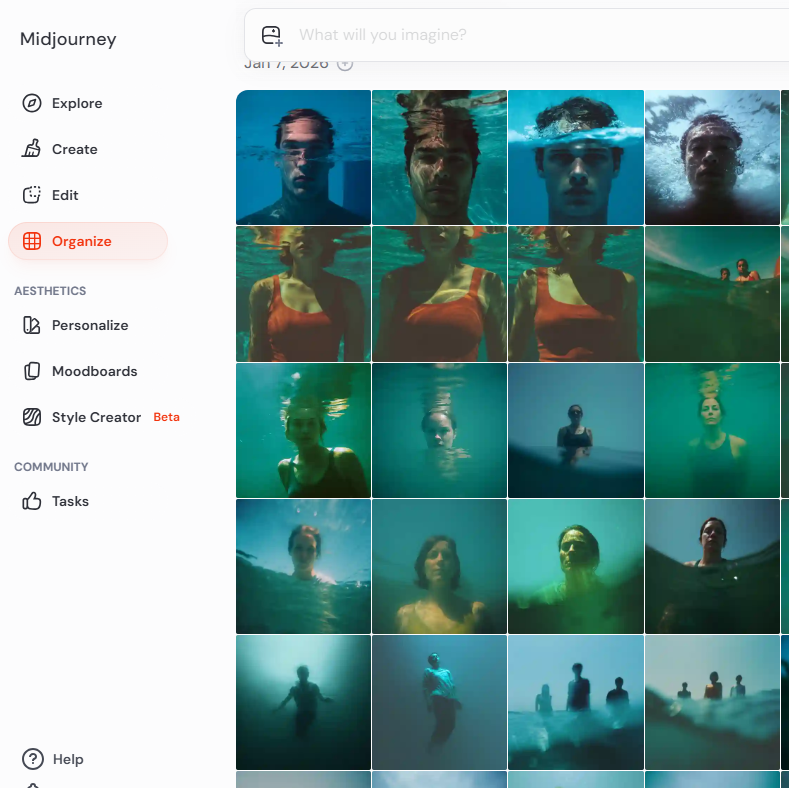
There's a lot of conversation right now about AI and art.
Most of it is abstract. People debating definitions, defending positions, drawing lines.
This post isn't that.
This is just an honest account of how I actually use Midjourney in my practice — what I'm looking for, what I throw out, and how I decide when something is worth keeping.
I Use It Three Different Ways
Midjourney isn't one thing in my process. It shows up differently depending on what I'm trying to do.
As reference for traditional work. I work literally from visual reference. I don't conjure detailed images internally and then execute them — my process moves in the opposite direction. I need to see something before I can respond to it, refine it, or decide it's worth pursuing. For me, Midjourney isn't a shortcut around imagination. It's how my imagination works externally. I've written about this more fully in [How Artists Imagine: Why Creative Process Doesn't Look the Same for Everyone →] — but the short version is that cognitive variation in visual imagery is real, well-researched, and more common among artists than most people assume. Using a tool that externalizes possibilities isn't a lesser process. It's just a different one.
For exploring compositions before committing. Before I invest time and materials in a traditional piece, I want to know the composition holds. Generating variations lets me test different framings, different focal points, different arrangements — fast. What would this look like with the figures closer? What if the horizon were lower? What if there were more negative space on the left? I can answer those questions in minutes rather than hours.
For finished images I refine and present as work. Sometimes the output itself is the work. Not every generation — most get discarded. But occasionally something comes back that has the quality I was after, and with refinement and intention behind it, it becomes a piece I stand behind.
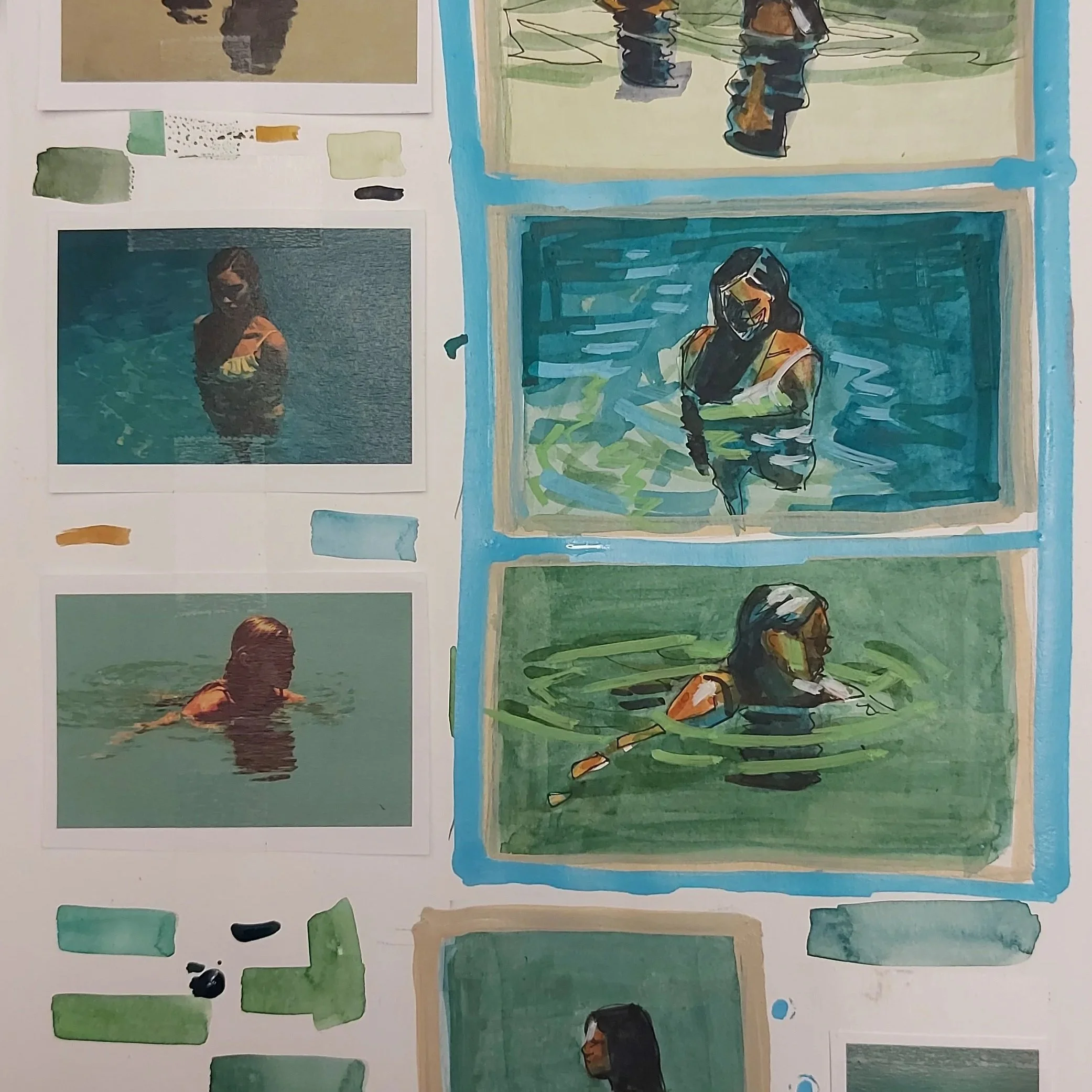
Watercolor sketches from the original images
What I'm Actually Looking For
When a batch of images comes back, most people probably look at them and pick the prettiest one.
That's not what I do.
The first thing I look at is composition and framing. Before mood, before colour, before detail — does this image have a structure that works? Is there a clear focal point? Does the eye have somewhere to travel? Is there balance without being static?
Colour can be adjusted. Mood can be refined. But if the underlying composition is weak — if the elements are competing instead of supporting each other — no amount of refinement fixes it. A bad composition is a bad painting, regardless of how beautiful the surface is.
So I'm looking for structure first. Everything else comes after.
The Part Nobody Talks About — The Rejection
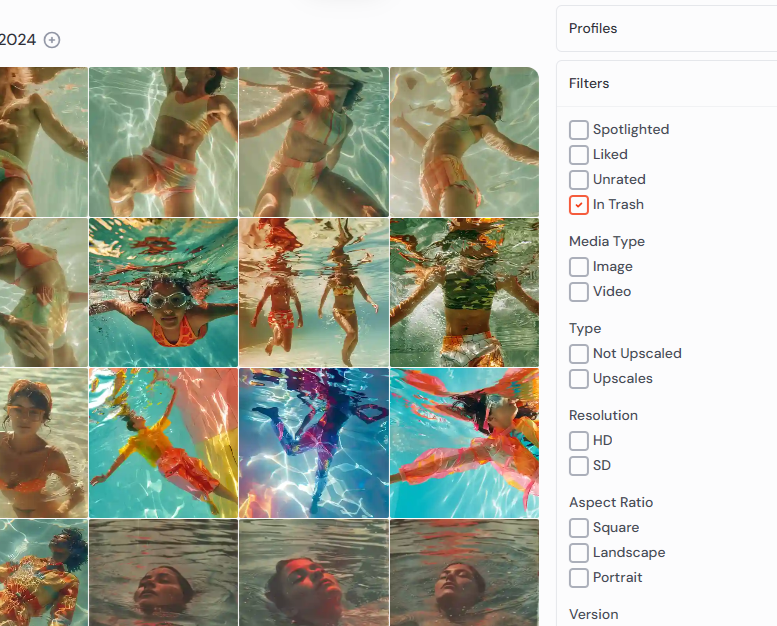
Here's what the conversation about AI art almost always leaves out: the volume of rejection involved in doing this well.
Before I find one image worth keeping, I generate dozens. Sometimes many more.
That's not a failure of the tool. That's the work.
Every batch that comes back is a series of decisions. This one is close but the framing is too tight. This one has the right mood but the figures are placed wrong. This one is technically interesting but there's nothing to come back to — it gives everything up in the first glance. This one has a quality I want but it's trying too hard. Delete. Delete. Delete. Keep.
The rejection is where the artistic judgment lives. Anyone can generate images. The eye that knows what to discard — that's the skill. And that skill is built the same way it's always been built: through looking at a lot of art, understanding why things work, and developing a standard you won't compromise on.
That's why Feldman's framework — Describe, Analyze, Interpret, Judge — is as relevant here as it is in front of a painting in a gallery. I'm applying the same critical process to my own generated output that I'd apply to anyone else's work. Most of it doesn't pass. The pieces that do are the ones where every element supports every other element and there's something left over for the viewer to bring.
The Question I Get Asked — and How I Answer It
Do I tell people my finished works started in Midjourney?
Sometimes. It depends on the context.
If someone asks directly, I'm honest. If the conversation is about process, I'm open about it — like I am here. But I don't lead with it in every room, because in some conversations it closes the door before the work gets a fair look. And I think the work deserves a fair look first.
I'm still figuring out exactly how to talk about this publicly. I don't think I'm alone in that. A lot of artists are working with these tools and navigating the same uncertainty — how much to disclose, when, and to whom.
What I've landed on for now is this: I don't hide it, and I don't apologize for it. The decisions I make in the process are real artistic decisions. The judgment I apply is real artistic judgment. The standard I hold the work to is the same standard I'd apply to anything else I made.
That feels like enough of a foundation to stand on.
What This Process Has Taught Me
Working this way has sharpened something I didn't expect.
Because I'm generating so many versions and rejecting most of them, I've had to get very clear — faster than I ever did with traditional work — about exactly what I'm looking for. You can't reject dozens of images without developing a precise understanding of why each one fails.
That clarity has fed back into everything else I do. My eye is sharper. My standards are higher. My ability to articulate why something works or doesn't has improved because I've had to practice it, repeatedly, at volume.
That's not what people expect to hear about AI tools. But it's what's been true for me.
The Honest Summary
I use Midjourney as reference. I use it to test compositions. I use it to make finished work.
In every case, the process involves generating far more than I keep, filtering everything through the question of whether the composition holds, and applying the same critical standards I'd bring to any other piece of art.
The tool is fast. The judgment is slow. That's intentional.
Because the work that comes out the other side isn't defined by how quickly it was made. It's defined by how carefully it was chosen.
FAQ
Is using Midjourney cheating as an artist? Not in my view — and I say that as someone who uses it. The tool generates options. The artist makes decisions. Rejecting dozens of versions before finding one worth keeping is not a passive process. It requires a developed eye and a clear standard.
Do all artists visualize their work internally before starting? No — and the research backs this up. Visual imagery exists on a spectrum, from aphantasia (no internal imagery) to hyperphantasia (extremely vivid internal imagery). Artists who work more literally from external reference aren't less imaginative — they just externalize their process differently. I've written about this in depth in How Artists Imagine: Why Creative Process Doesn't Look the Same for Everyone →.
How do you use Midjourney for traditional painting reference? I generate images that capture a mood, light quality, or composition I have in mind — things that are difficult to find in stock photography. Because I work literally from visual reference, this isn't a supplement to my process. For me, it is the process. I need to see it before I can respond to it.
What makes a Midjourney image worth keeping? For me, composition and framing come first. If the underlying structure doesn't work — if there's no clear focal point, no visual logic, no sense of balance — nothing else saves it. Most generated images fail this test. The ones that pass are worth refining.
How many images do you generate before finding one you use? Dozens, typically. Sometimes more. The rejection rate is high by design. That's where the judgment lives.
Should artists disclose when they use AI tools? I think honesty serves everyone better in the long run. How and when that disclosure happens is something each artist has to navigate for themselves — but I don't think hiding it is a sustainable position as these tools become more widespread.
Closing Link to the Series
This post is part of an ongoing series on art, tools, and judgment. If you're new here, start with
Is AI Art Really Art? → — then see the framework I use to evaluate work in Why Some Paintings Work and Others Don't →.
And if you want to understand why creative process looks different for every artist, read How Artists Imagine →.