How Artists Imagine: Why Creative Process Doesn’t Look the Same for Everyone
Written by Vanessa Corrigall + ChatGPT 5.2
Understanding the creative imagination spectrum helps collectors look past assumptions and see artistic intent, coherence, and craft more clearly.
Many collectors assume that every artist begins with a fully formed mental image — that the finished artwork was “seen in the mind first.” But research on visual imagery shows that people vary widely in how (or whether) they visualize internally. This isn’t a limitation — it’s a variation in cognitive style that shapes creative process without determining artistic quality.
This article explains why artists don’t all imagine the same way, what that means for collecting, and how both traditional and AI‑assisted creative tools support diverse imaginative approaches.
What Is Visual Imagery in Creative Thinking?
At its core, visual imagery is the experience of creating “pictures in the mind’s eye.” But rather than being uniform across individuals, imagery exists on a spectrum — from those with little to no internal visualization to those whose imagery feels exceptionally vivid. Understanding this helps answer common questions like: “Do all artists visualize their work before starting?” and “What does it mean if an artist doesn’t ‘see it first’?”
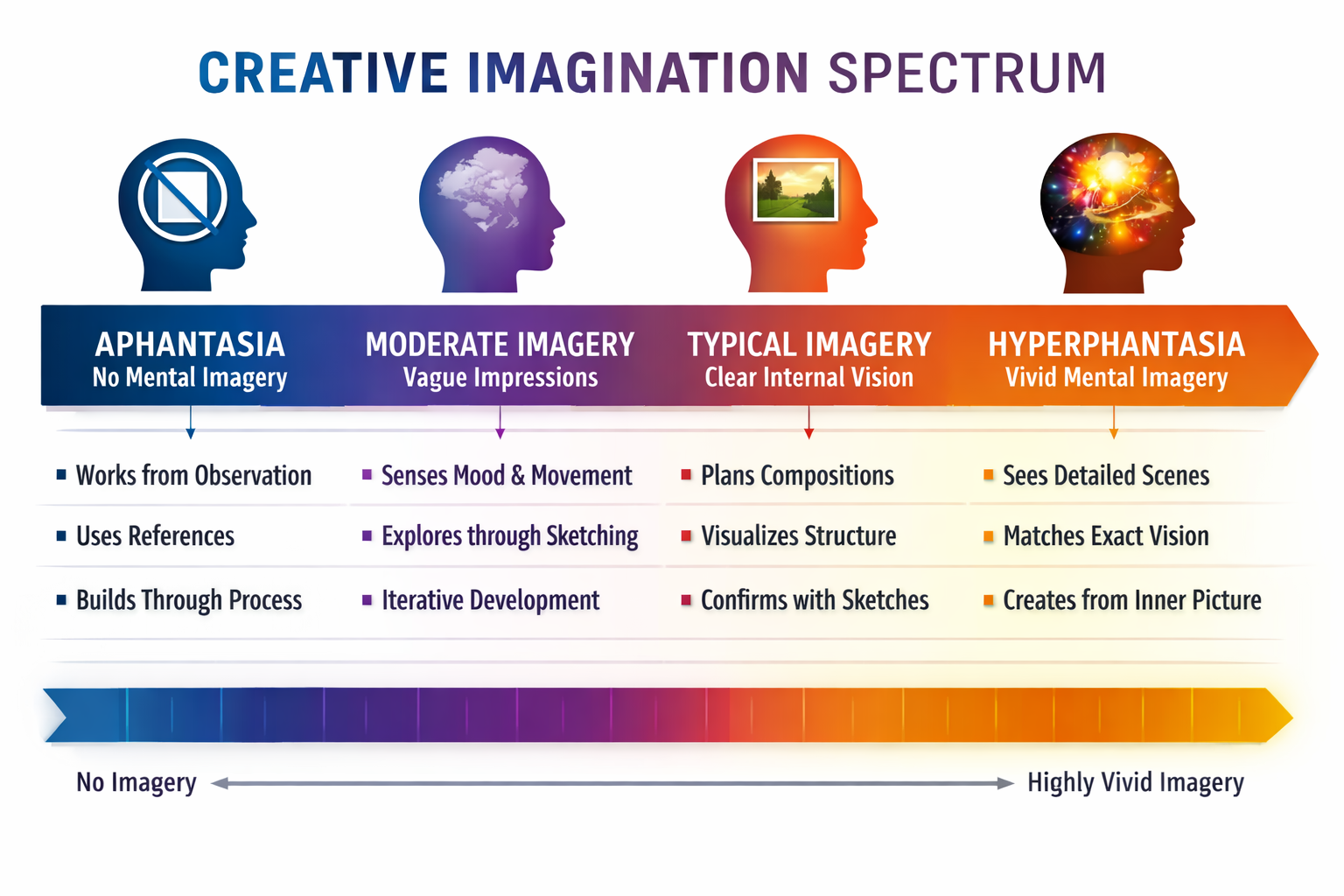
This infographic titled “Creative Imagination Spectrum” visually maps out the range of mental imagery among artists. It spans from Aphantasia (no mental imagery) on the left to Hyperphantasia (vivid mental imagery) on the right. Each category is illustrated with a distinct head profile icon and labeled:
Aphantasia: Works from observation, uses references, builds through process.
Moderate Imagery: Senses mood and movement, explores through sketching, develops iteratively.
Typical Imagery: Plans compositions, visualizes structure, confirms with sketches.
Hyperphantasia: Sees detailed scenes, matches exact vision, creates from inner picture.
A gradient color bar below the categories transitions from cool blue (no imagery) to warm orange (highly vivid imagery), reinforcing the spectrum visually.
Across the Imagery Spectrum: What Collectors Should Know
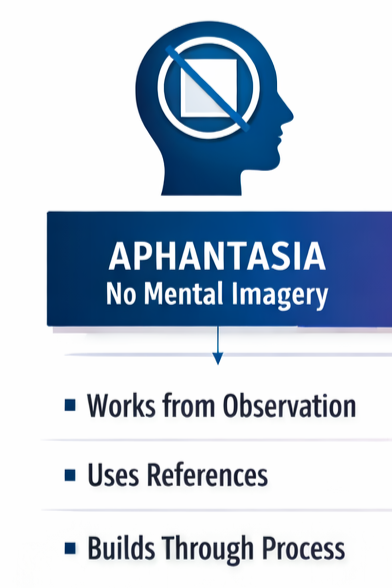
1. Artists with Aphantasia — Creativity Without Internal Pictures
Some artists don’t form visual images internally at all — a trait called aphantasia. These creators don’t “see the work in their head,” but they are still deeply visual thinkers.
Instead of mental images, they may:
Use references, observation, and materials to shape ideas.
Sketch and iterate as part of discovery.
Rely on externalization early and often.
This approach can be just as intentional and expressive as internal visualization. So when collectors ask, “Can an artist be thoughtful if they don’t visualize first?” the answer is a resounding yes. Their tools — sketchbooks, cameras, mood boards, sculpture maquettes, or digital interfaces — become extensions of their imagination.
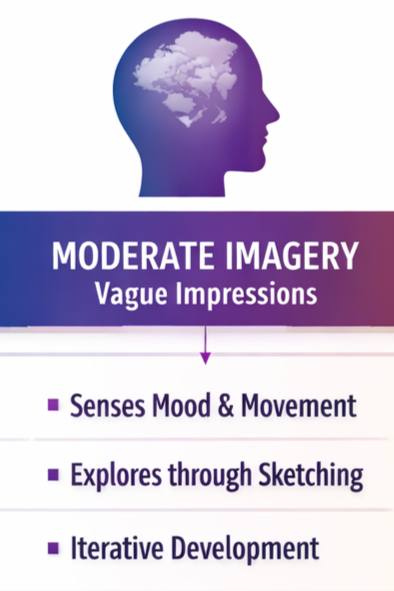
2. Artists with Moderate Imagery — Impressions That Emerge Into Form
Many artists experience some internal imagery — not detailed visuals, but impressions of mood, structure, or movement. These creators often describe starting with:
Feeling or atmosphere rather than fully formed images.
Exploration through materials instead of pre‑planned outcomes.
Evolving meaning as forms take shape.
Collectors who wonder “Why does this artist change direction as they work?” can see this as part of an exploratory process rather than uncertainty.
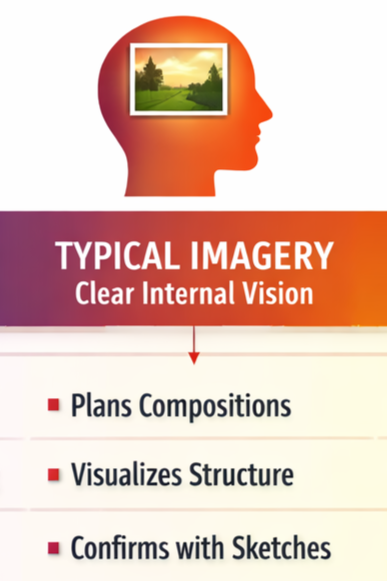
3. Artists with Typical Imagery — Internal Planning and Intent
A large group of creators can intentionally visualize scenes and compositions with moderate clarity. These artists often:
Visualize elements like color, balance, and form before execution.
Use sketches to confirm ideas rather than discover them.
Approach work with a stronger plan from the outset.
For collectors, this aligns with traditional notions of creative intent and supports questions like, “Did the artist plan this before beginning?”
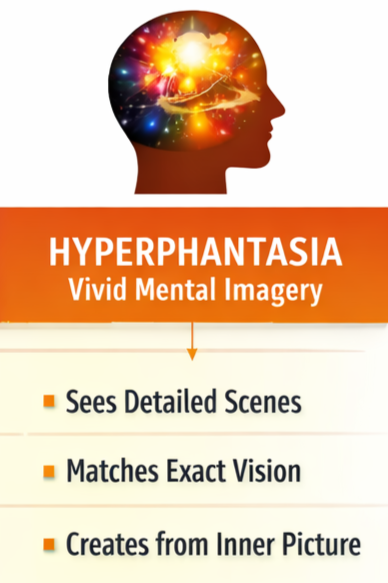
4. Artists with Hyperphantasia — Vivid Internal Vision First
At the opposite end of the spectrum are artists who experience extremely vivid internal imagery — sometimes feeling nearly as clear as perception itself. These creators:
Often see a detailed version of the work in their mind before making.
Translate that immersive vision into the final piece.
May describe their process as fulfilling a pre‑existing internal picture.
For collectors asking, “Does this artist see the artwork before it exists?”, hyperphantasia offers an explanation that’s grounded in cognitive variation — not mystique.
How AI‑Assisted Creative Tools Fit Into the Imagination Spectrum
As AI tools become part of creative practices, they intersect with all points of the imagery spectrum — not as replacements for human creativity, but as extensions of it.
Whether an artist naturally visualizes internally or works through external exploration, AI can support:
Idea generation: Helping translate vague impressions into visual suggestions.
Reference exploration: Offering variations on themes or compositions.
Iterative refinement: Enabling artists to experiment faster through generative drafts.
Bridging gaps: For creators with faint or no internal imagery, AI tools can visualize possibilities that spark further iteration.
So when collectors ask, “Do AI tools replace real imagination?” the better question is: How do tools, human cognition, and intentionality combine in the creative process?
AI‑assisted creativity doesn’t replace imagination — it expands the ways artists externalize and refine their ideas, whether those ideas start internally, externally, or somewhere in between.
Why This Matters for Collectors’ Confidence and Discernment
Understanding the spectrum of visual imagery helps collectors avoid a common trap: assuming that one type of creative process defines seriousness, intention, or authenticity.
Instead, keep in mind:
Strong work can emerge from planning or discovery.
Internal visualization is not required for intention.
External tools — from sketchbooks to AI — do not imply weaker authorship.
Variation in process often reflects cognitive diversity, not inconsistency.
When you find yourself wondering, “Does this artist favor intuition or pre‑visualization?”, remember that neither approach is inherently better — they’re just different paths to meaningful work.
Focus on What Matters: Questions That Reveal Process and Intent
Instead of asking, “Did the artist see it first?” try questions like:
What is the artist exploring?
How are decisions made during the process?
Is the work coherent over time?
Does the creative journey align with the outcome?
These questions help collectors evaluate work based on intent, coherence, and care — the standards that truly matter.
A Grounded Takeaway for Collectors
Imagination isn’t a single experience — and neither is artistic process.
Some artists imagine internally.
Some imagine externally.
Most move between the two.
Some use AI tools to imagine even more possibilities.
For collectors, recognizing this diversity sharpens discernment rather than blurring it — allowing artwork to be evaluated on substance, intention, and meaning rather than assumptions about mental imagery.
References:
Zeman, A. (2024). The mind’s eye: Aphantasia and hyperphantasia.
Wright, R. et al. (2024). The spectrum of visual imagery vividness.
Palmiero, M. et al. (2015). Visual imagery and visual creativity.