Is AI Art Really Art? What History — and Experience — Tell Us
Recently, I came across several artist calls with one thing in common: "No AI-generated artwork."
At the same time, more artists than ever are quietly experimenting with AI as part of their process.
So the question keeps surfacing:
Is AI art really art?
It's fair. But it's not new.
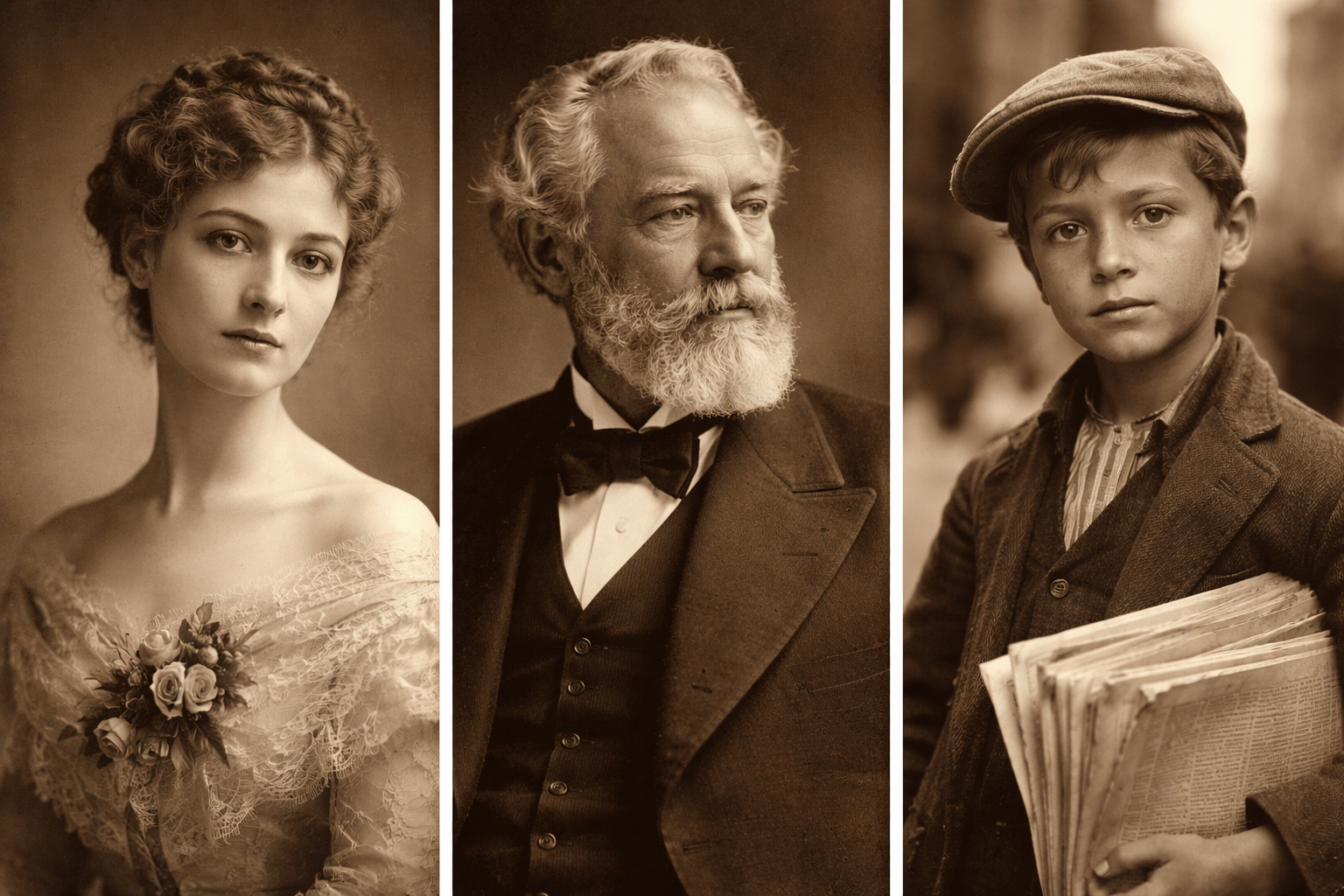
Generated images of Sepia Photos
We've Had This Debate Before — With Photography
When photography arrived in the 1800s, painters rejected it almost immediately.
The complaints were familiar:
"The machine does the work." "There's no real skill." "This isn't true art."
And honestly? At the time, those concerns made sense. Painting had long been valued for its ability to capture reality — light, likeness, detail. A camera could suddenly do that faster and more accurately than any hand.
It felt like a loss.
But here's what actually happened: painting didn't disappear. It changed.
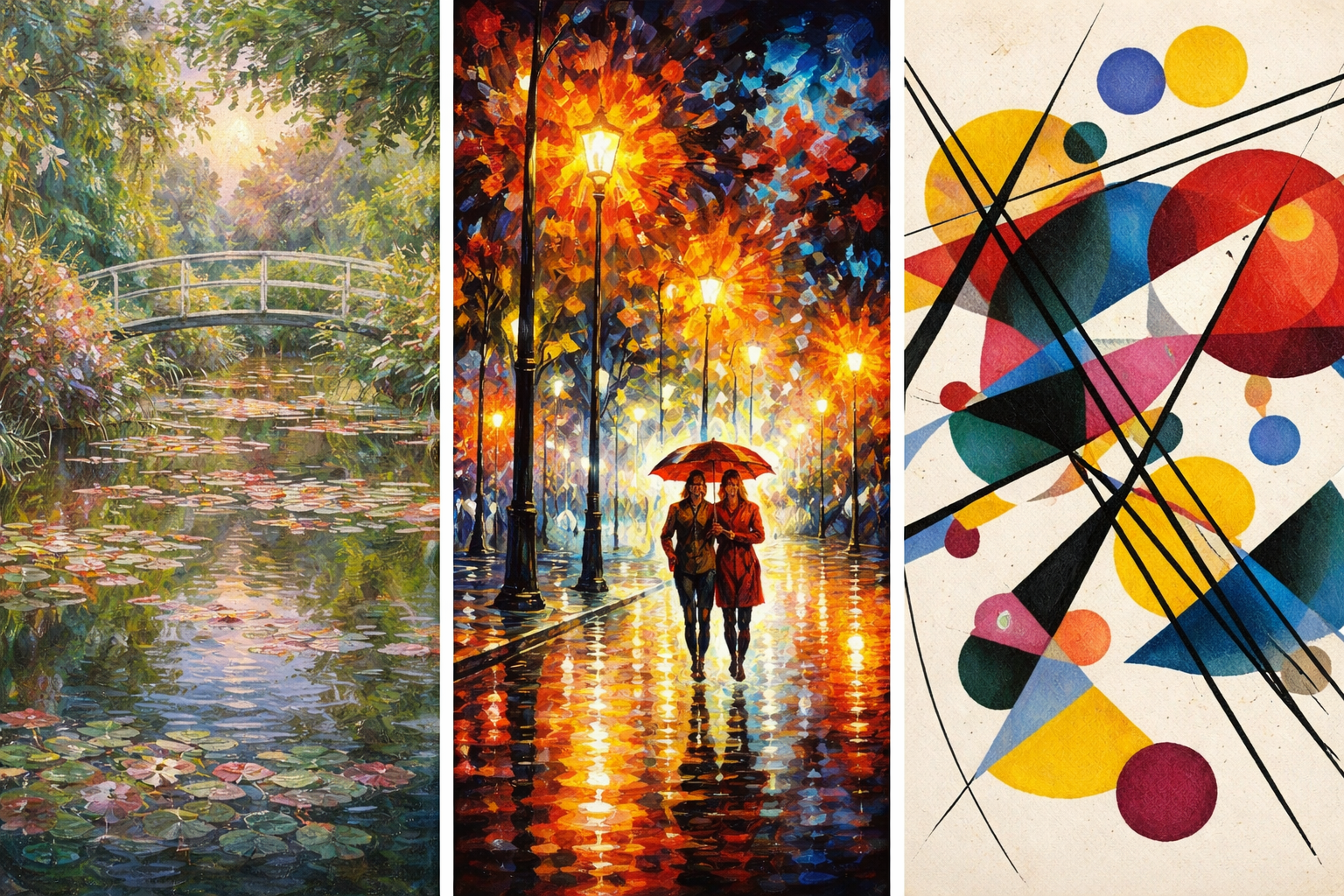
Generated images created that follow the ideas of: Impressionism, Expressionism, Abstraction
When a New Tool Arrives, Art Shifts
Once photography took over the job of recording reality, painters were freed from that responsibility.
Instead of asking Can I copy what I see? — artists began asking How do I interpret what I see?
That shift gave rise to Impressionism, Expressionism, and abstraction. The focus moved from technical accuracy toward emotion, perception, and meaning.
That shift still shapes how we understand art today.
And it's worth asking: are we watching a similar shift happen right now with AI?
Two Different Definitions of Art — Both Valid
A lot of the tension around AI-generated art comes down to something deeper than tools.
We don't all share the same definition of what art is.
Art as skill and craft — This view values the artist's hand, mark-making, years of technical training, and control over materials. It's the tradition behind juried shows, federations, and competitions. When organizations exclude AI-assisted work, they're often not saying it isn't art — they're saying: this space celebrates human-made craft.
Art as idea and meaning — In this view, art is about concept, intention, and interpretation. The artist doesn't need to physically make every element. They direct, select, edit, and refine. This approach has been part of contemporary art for decades — and it's where AI tends to fit most naturally.
Neither definition is wrong. They're asking different questions.
What AI Actually Changes (It's Not What You Think)
There's a common assumption that AI removes skill from art.
That's not quite accurate. It moves where the skill lives.
Traditionally, a lot of artistic effort went into execution — drawing accurately, controlling paint, building form. With AI-assisted tools, some of that execution becomes faster or easier.
So the artist's role shifts from Can I draw this? to What image should exist?
That brings in a different — not lesser — set of skills: visual judgment, concept development, editing and selection, understanding of context and meaning.
The work doesn't disappear. It moves.
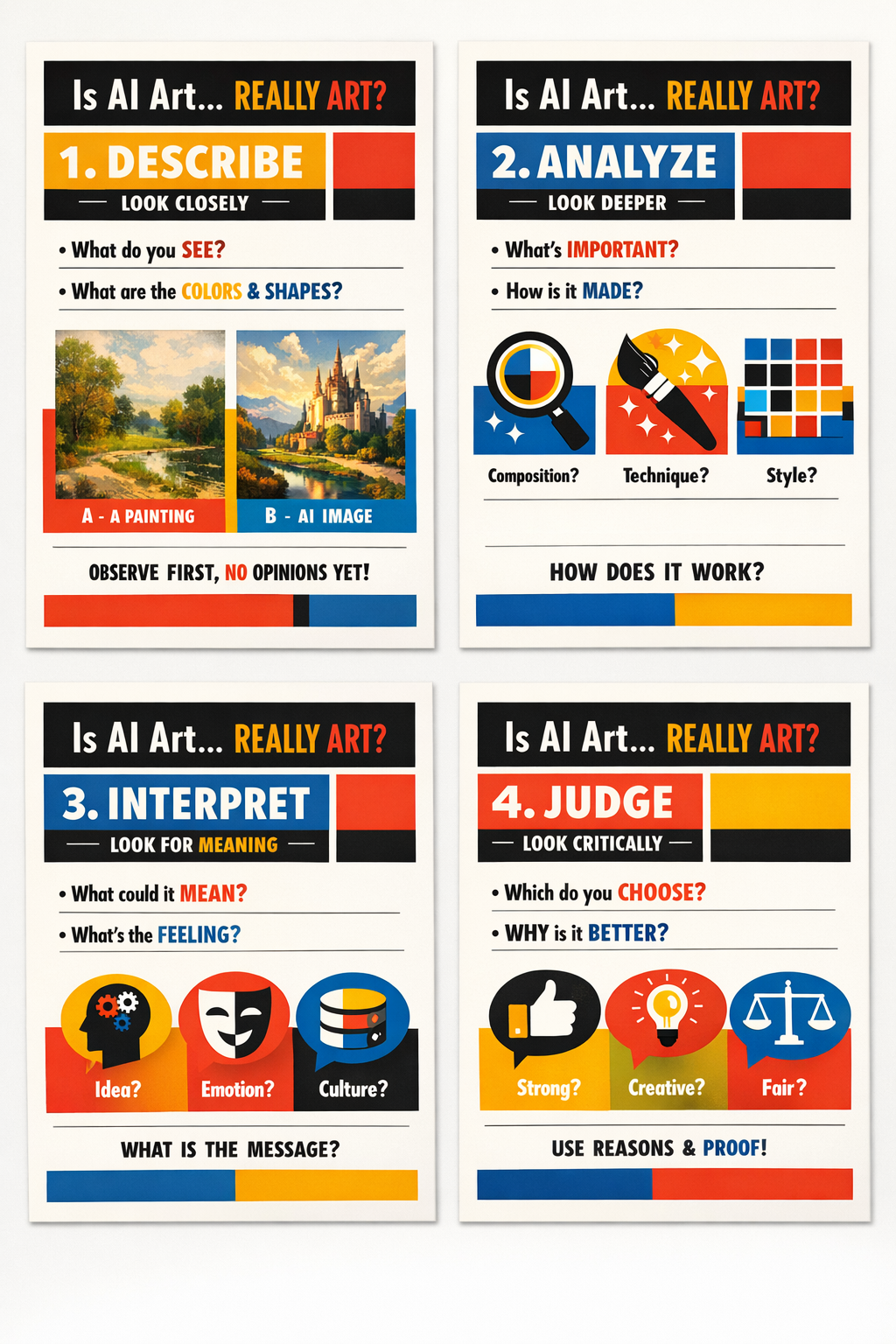
How the Alberta Art Curriculum Approaches Criticism — and Why It Matters Here
Part of what's shaped my thinking on this is digging into the frameworks behind the Alberta Art 10–30 curriculum — not just the assignments, but the actual theoretical foundations the program is built on.
One of the central ones is Edmund Burke Feldman's four-stage model of art criticism. It's not incidental to the curriculum — the Alberta guide explicitly describes Feldman's inductive approach as the backbone of how students are taught to engage with art across all three grade levels.
The four stages are:
Description — What do you observe? Subject matter, materials, surface qualities, technique.
Analysis — How do the parts relate? Colour, shape, emphasis, composition.
Interpretation — What might it mean? Multiple readings are encouraged, not just one.
Judgement — Based on everything gathered, does the work succeed? This is deliberately the last step — not the first.
That last point is worth sitting with. The curriculum is designed so that personal preference is delayed until students have processed as much visual information as possible. Judgement is earned through looking, not assumed from the outset.
What strikes me about this framework — now that I've spent time with the actual curriculum documents — is how durable it is. Feldman developed it to work across a wide range of art forms. The Alberta guide describes it as something students can carry beyond the classroom and apply to any work they encounter in the world.
Including, as it turns out, AI-generated images.
Describe what you see. Analyze how it works. Interpret what it might mean. Then — and only then — judge.
That sequence doesn't care what tool made the image. It asks the viewer to do the work regardless.
AI Art and the Pattern of Art History
If you look at how art has responded to new tools, there's a recognizable pattern:
A new tool appears → artists resist → separate categories form → over time, it becomes part of the landscape.
Photography went through this. Digital art went through this. AI is going through it right now.
Many organizations are still in that early stage — setting limits, protecting standards, figuring out what's fair. That's not wrong. It's part of the process.
The Better Question Isn't "Is It Art?"
Instead of asking Is AI art real art? — it might be more useful to ask:
What choices did the artist make? What are they responsible for? Where did the imagery come from? What is the work saying? What does it ask of the viewer?
These questions go deeper than the tool. They move us toward meaning — which is where art has always lived.
Where I Land
AI isn't the first tool to challenge what we think art is — and it won't be the last.
What matters isn't only how something is made. It's whether the work holds attention, communicates something, invites reflection, or stays with you after you've moved on.
Art has always existed somewhere between the tool, the artist, and the meaning we bring to it.
That hasn't changed.
Frequently Asked Questions About AI Art
Is AI-generated art considered real art? It depends on your definition. Those who value craft and the artist's hand often say no. Those who focus on concept and intention often say yes — and point out that artists have always used tools.
Why do some art shows and galleries ban AI artwork? Many are focused on celebrating human-made craft, maintaining fairness in competition, and navigating unresolved questions around copyright and image sourcing.
Does using AI mean an artist is cheating? It changes the process, but not the need for decision-making, visual judgment, and intention. The craft shifts — it doesn't disappear.
Will AI replace traditional artists? History suggests otherwise. New tools have consistently expanded what art can be, rather than replacing the artists who came before.
What is the Feldman method of art criticism? Feldman's four-stage approach — Description, Analysis, Interpretation, and Judgement — is a systematic way of looking at art that delays personal opinion until after careful observation. It's embedded in the Alberta Art 10–30 curriculum and works across virtually any art form, including AI-generated work.
What is the debate around AI art really about? At its core, it's a debate about two different definitions of art — craft and skill versus idea and meaning — that have existed long before AI arrived.
The framework is only useful if you know how to apply it. In my next post, I walk through Feldman's four steps using two real images — both made with AI — to show exactly what separates a painting that works from one that doesn't. Read: Why Some Paintings Work (and Others Don't) →