The Institutional Read: How Contemporary Art Practices Are Evaluated
Most artists are taught the elements of art and the principles of design. These frameworks describe how images are constructed — composition, balance, contrast, rhythm, color.
They do not address how entire practices are assessed within museums and other institutional contexts.
Curators, critics, and collecting institutions rely on a parallel set of criteria every day. These criteria are rarely formalized as a checklist, yet they shape what is exhibited, collected, written about, and sustained over time.
This post outlines that logic.
It describes recurring patterns used to evaluate contemporary art practices within institutional settings.
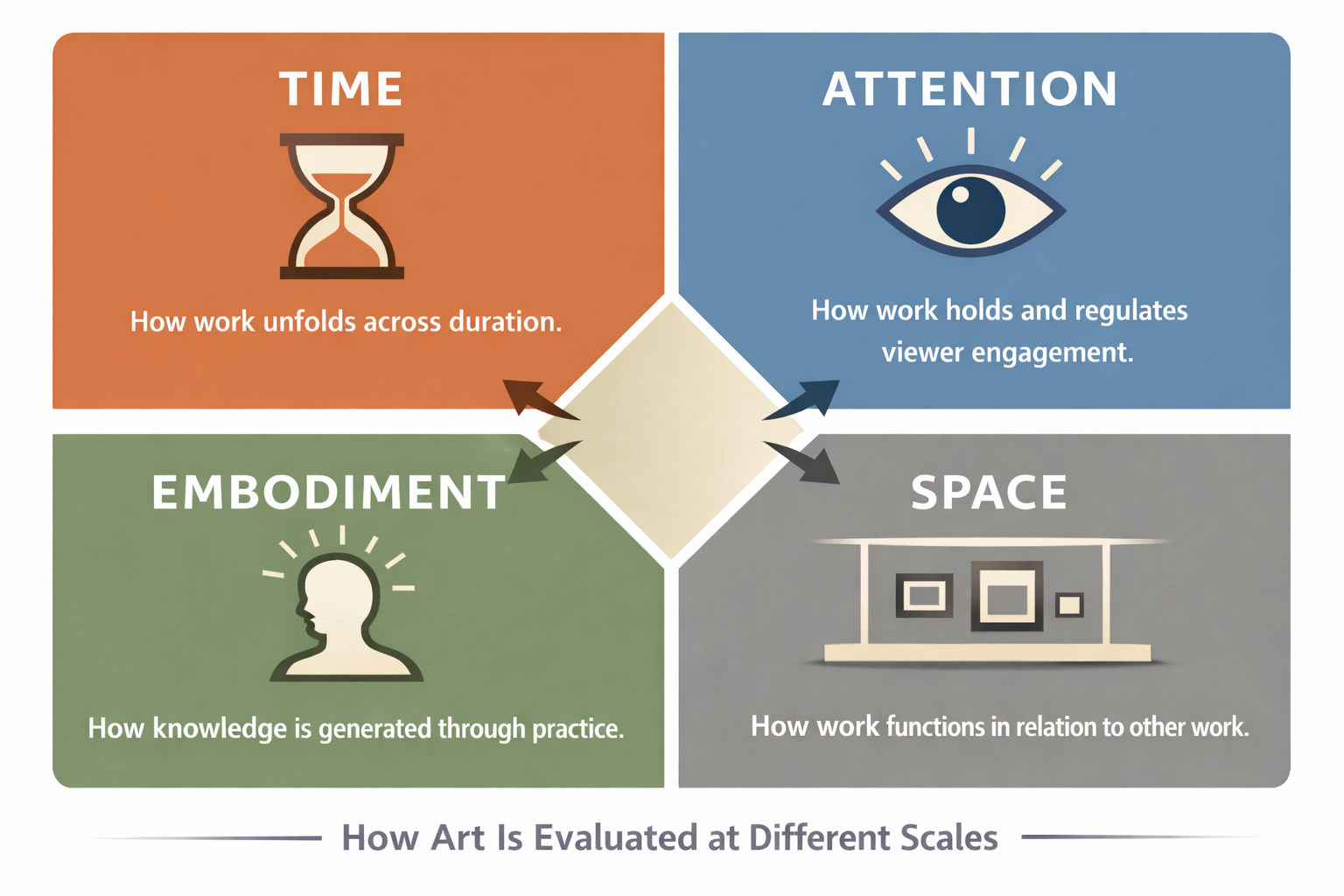
The Institutional Read
In curatorial writing and museum studies, practices are commonly evaluated through four overlapping lenses:
Time — how work unfolds across duration
Attention — how work holds and regulates viewer engagement
Embodiment — how knowledge is generated through practice
Space — how work functions in relation to other work
Together, these lenses form a shared way of reading practices over time — a framework that operates across institutions, even when it remains unnamed.
I. Time
How work exists across duration
Institutions prioritize practices that develop over extended periods.
Key considerations include:
Sustained inquiry
Work unfolds across years, allowing questions to deepen over time.Repetition with difference
Variation accumulates gradually, creating meaning through return.Slowness and duration
The work supports extended looking and sustained attention.
Time-based seriousness signals continuity.
How work unfolds across duration
Where this comes from
This lens emerges from postwar modernism and solidifies in post-1960s criticism, when museums shifted attention away from singular masterpieces toward practices that persist over time.
Key idea:
Meaning accumulates through duration, repetition, and sustained inquiry.
Key thinkers
Gilles Deleuze — Difference and Repetition
Repetition is not sameness. Difference emerges slowly, perceptually, over time.James Elkins — writes extensively on long-form artistic inquiry and the limits of snapshot interpretation.
Hito Steyerl — frames contemporary art as time-based circulation, not fixed objects.
Artists whose work is read through TIME
On Kawara — Today Series
Each painting is minimal; the practice becomes the meaning.Agnes Martin — decades of restrained variation where duration is inseparable from form.
Roman Opalka — life-long counting as artwork.
II. Attention
How work manages viewer engagement
Institutional contexts value controlled attention.
Key considerations include:
Restraint as authority
Withholding spectacle and overt emotional cues establishes confidence.Ambiguity without obscurity
The work remains visually legible while meaning stays open.Experiential meaning
Interpretation emerges through engagement.
Attention is shaped through pacing, omission, and editorial judgment.
How work holds and regulates viewer engagement
Where this comes from
This thread runs through mid-century criticism reacting against spectacle and theatricality.
Key idea:
Authority appears through restraint and refusal.
Key thinkers
Susan Sontag — Against Interpretation
Advocates for presence, sensorial engagement, and experience before explanation.Michael Fried — Art and Objecthood
Introduces the idea of “anti-theatricality” — work that does not perform for the viewer.
Artists whose work operates through ATTENTION
Ellsworth Kelly — holds attention without narrative.
Roni Horn — water as perceptual restraint (Still Water series).
Hiroshi Sugimoto — minimal imagery demanding prolonged looking.
III. Embodiment
How knowledge is produced
Many contemporary practices are understood through how they think with the body.
Key considerations include:
Embodiment as a way of knowing
Knowledge arises through perception, repetition, and lived rhythm.Practice as thinking
Meaning develops through material decisions and sustained process.Quiet politics
Care, endurance, and sustained attention carry cultural weight.
Embodied practices demonstrate commitment through consistency and presence.
How knowledge is generated through practice
Where this comes from
Rooted in phenomenology and feminist theory, later absorbed into contemporary art discourse.
Key idea:
Knowing happens through the body, repetition, and lived experience.
Key thinkers
Maurice Merleau-Ponty — Phenomenology of Perception
Perception is embodied, not abstract.Amelia Jones — argues for embodied subjectivity as legitimate knowledge.
Erin Manning — movement as thinking.
Artists whose work demonstrates EMBODIMENT
Ana Mendieta — body as site, not symbol.
Tehching Hsieh — endurance as epistemology.
Rineke Dijkstra — bodies understood through repeated conditions.
IV. Space
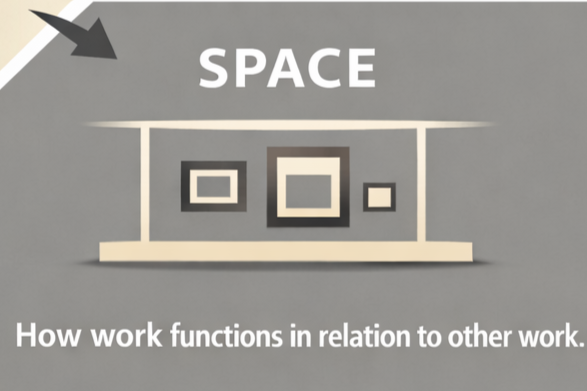
How work behaves in relation to other work
Museums evaluate work spatially.
Key considerations include:
Cohesion without redundancy
Repetition strengthens meaning while maintaining variation.Installation consciousness
The work accounts for pacing, negative space, and physical context.Relational silence
Works coexist without competing for attention or narrative dominance.
Spatial intelligence allows a practice to operate as an environment.
How work functions in relation to other work
Where this comes from
This lens develops alongside installation art and institutional critique.
Key idea:
Meaning emerges through placement, pacing, and proximity.
Key thinkers
Brian O'Doherty — space is not neutral.
Miwon Kwon — site shapes interpretation.
Claire Bishop — analyzes relational and spatial dynamics.
Artists whose work is spatially literate
Wolfgang Tillmans — images gain meaning through constellation.
Tauba Auerbach — spatial rhythm over singular image.
Donald Judd — sequence and spacing are content.
The Expanded Framework (How This Appears in Practice)
Across these four lenses, institutional evaluation often centers on the following principles:
Sustained inquiry
Repetition with difference
Slowness and duration
Restraint as authority
Ambiguity without obscurity
Experiential meaning
Embodiment as knowledge
Practice as thinking
Quiet politics
Cohesion without redundancy
Installation consciousness
Relational silence
Consistency across time
Legibility of intent
These principles function as signals that help position a practice within a broader curatorial and critical context.
How Art Is Evaluated at Different Scales
| Focus of Evaluation | Image-Level Framework | Practice-Level Framework |
|---|---|---|
| Primary Unit | Individual works | Sustained practices |
| Time Scale | Immediate | Long-term |
| Core Concern | Formal construction | Endurance and coherence |
| Evaluation Language | Line, color, form, balance | Time, attention, embodiment, space |
| Typical Question | “How is this made?” | “How does this hold over time?” |
| Context | Studio critique, classroom | Museum, collection, exhibition |
These two frameworks operate at different scales. One evaluates how individual works are constructed. The other evaluates how practices function over time.
A Practical Self-Check
When making curatorial, studio, or exhibition decisions, the following questions help clarify how work may be read institutionally:
Does this extend the inquiry across time?
How is attention being managed?
Does meaning emerge through engagement?
How does this deepen through proximity to related work?
Does this reflect the current direction of the practice?
These questions support clarity in decision-making.
Closing
Institutional evaluation focuses on how practices sustain attention, develop coherence, and remain legible over time.
Understanding this logic supports clearer choices in the studio, in exhibition planning, and in collecting. It provides a shared vocabulary for conversations that often remain intuitive or implicit.
This framework will continue to evolve alongside the discourse it reflects.