Why Conversations About AI Art Can Feel Exhausting for Collectors — And How to Engage with Clarity
Written by Vanessa Corrigall + ChatGPT 5.2
Introduction
If conversations about AI art have been leaving you tired or overwhelmed, you’re not imagining it. Across social media, comment sections, auctions, and art-world headlines, opinions appear quickly and forcefully — often without shared context or common ground.
For collectors, this constant noise can crowd out something essential: the quiet attention that thoughtful collecting requires.
Understanding why these conversations feel so charged can help you stay grounded — and reconnect with the kind of engagement that drew you to art in the first place.
This post builds on AI Art and Ethical Collecting, which offers a broader framework for navigating these questions calmly and clearly. If you’re feeling disoriented, that guide is a good place to reset.
Why AI Art Conversations Escalate So Quickly
AI art discussions rarely unfold slowly. They tend to spike fast — not because the issues are simple, but because they’re often flattened into easy, shareable claims.
Complex questions about authorship, labor, originality, and ethics become headlines or hot takes. Instead of open inquiry, we get confident declarations. Reflection gets replaced by certainty.
Recent flashpoints — high-profile AI art auctions, public letters, petitions signed by thousands of artists — intensify this effect. These moments generate enormous attention, but they also push conversations into emotional territory, where nuance struggles to survive.
The result isn’t deeper understanding. It’s louder repetition.
The Emotional Weight Beneath the Debate
AI didn’t arrive in the art world as a neutral tool. It landed inside long-standing concerns about value, authorship, and creative labor.
For many artists, the debate touches livelihoods, consent, and recognition. Questions about training data and unlicensed imagery feel personal. When people sense that something foundational is being threatened, emotion naturally enters the conversation.
For collectors watching from the outside, this can feel destabilizing. You’re not just encountering a new tool. You’re witnessing a broader cultural reckoning — one that can make it harder to focus on what actually matters in your own collecting practice.
Where These Conversations Happen Shapes How They Feel
Platform matters.
Spaces designed for speed and engagement reward strong opinions and clear sides. Thoughtful perspectives — the kind that take time to form — don’t travel as well. They’re quieter, slower, and easier to miss.
This doesn’t mean informed discussion isn’t happening. It is — often among collectors, curators, artists, and institutions working carefully behind the scenes. But the public-facing version of the conversation can make the art world feel far more chaotic than it truly is.
What This Means for Thoughtful Collectors
When discourse becomes reactive, collectors can feel pressure to keep up — to have a position on every new development.
That pressure is a distraction.
Thoughtful collecting has always relied on slower questions:
What is the artist actually doing here?
How does this work fit within their broader practice?
What ideas or experiences does it carry forward over time?
Returning to these questions restores balance. They anchor your decisions in meaning, not momentum.
Remembering What Hasn’t Changed
While tools evolve, the ways we evaluate art remain surprisingly stable.
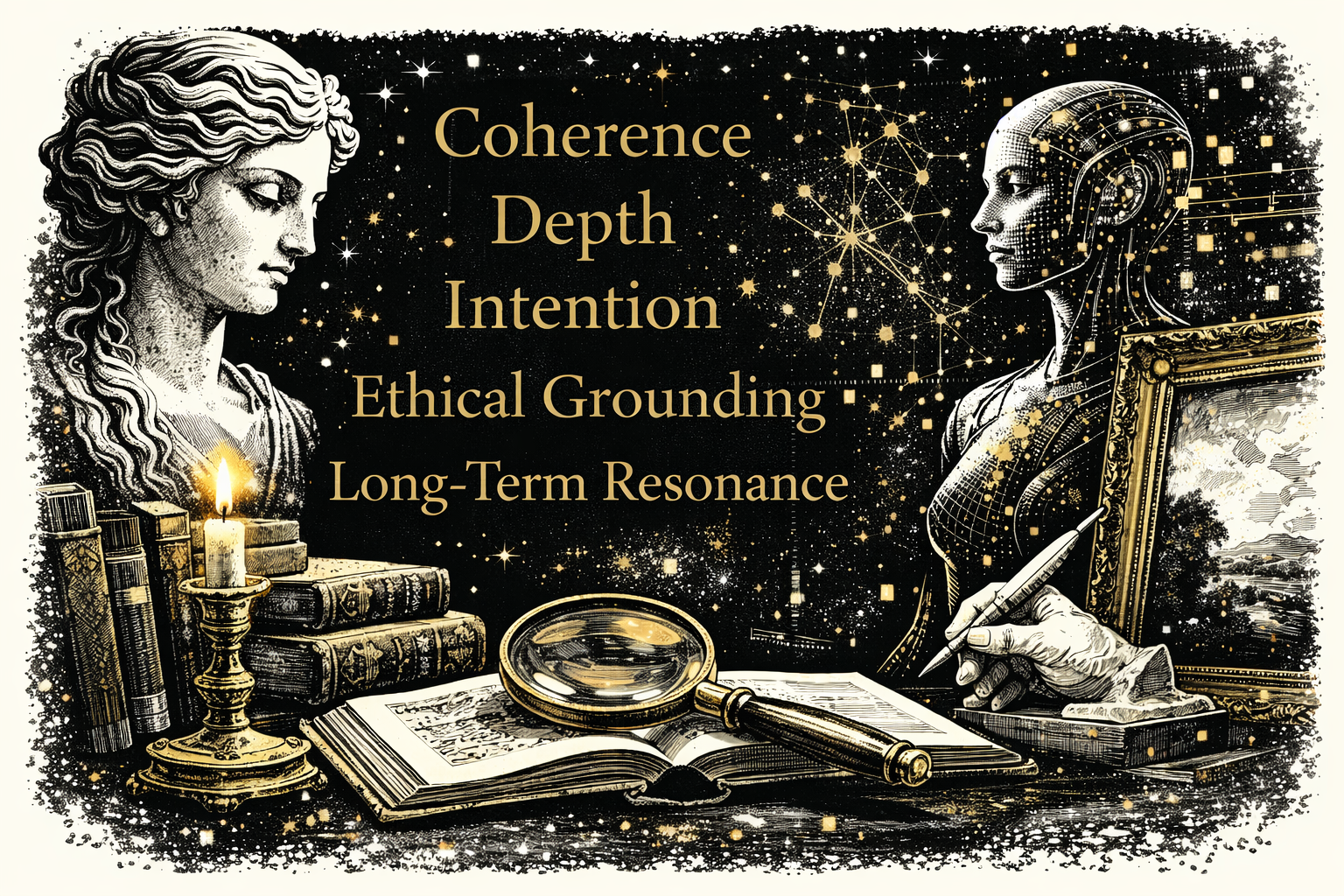
Serious collectors and institutions still look for coherence, depth, intention, ethical grounding, and long-term resonance. These criteria didn’t disappear with the arrival of AI — if anything, they’ve become more important.
When you recognize that evaluative frameworks endure, urgency fades. Curiosity replaces anxiety. You’re no longer reacting to every headline — you’re reading context again.
Here’s what those five criteria look like in practice, translated out of theory and into visual + experiential cues.
1. Coherence
What it looks like:
A sense that the work belongs together — with itself, and with the artist’s broader practice.
A consistent visual language
Recurring themes, questions, or environments
You can recognize the artist even when the subject changes
Collector instinct:
“This artist knows what they’re doing — and why.”
Coherence isn’t sameness. It’s clarity. AI doesn’t disrupt this — it often exposes when it’s missing.
2. Depth
What it looks like:
Work that rewards sustained looking.
Layers of meaning, not just surface impact
Visual decisions that feel intentional rather than decorative
A sense that something unfolds over time
Collector instinct:
“I keep noticing new things.”
Depth shows up in painting, photography, digital work, sculpture — and yes, AI-assisted work — when the artist is thinking beyond the first impression.
3. Intention
What it looks like:
Evidence of choice.
Why this subject, not another?
Why this process?
Why this moment in the artist’s practice?
You can feel intention even if you don’t know the full backstory. The work doesn’t feel accidental or interchangeable.
Collector instinct:
“This couldn’t have been made by just anyone.”
Tools don’t erase intention — they amplify whether it’s there.
4. Ethical Grounding
What it looks like:
Transparency and accountability.
Clear authorship
Honest discussion of process
Respect for sources, collaborators, and audiences
This isn’t about moral perfection. It’s about trust.
Collector instinct:
“I understand where this came from — and I’m comfortable standing behind it.”
In AI conversations, this is often where anxiety lives — but it’s also where clarity restores confidence.
5. Long-Term Resonance
What it looks like:
Work that doesn’t collapse once the novelty wears off.
It still holds meaning months or years later
It connects to larger cultural or personal narratives
It feels relevant beyond the current moment
Collector instinct:
“I’ll still care about this later.”
This is where trends fall away and collecting begins.
Why This Matters Now
When tools change quickly, it’s tempting to think everything has changed.
But these evaluative frameworks are stubborn — and that’s a good thing.
Once you recognize them:
Urgency softens
Anxiety drops
Curiosity returns
You stop reacting to headlines and start reading context again.
That’s not old-fashioned collecting.
That’s durable collecting — and it’s exactly why serious collectors remain steady even when the art world feels loud.
FAQ — Navigating AI Art Conversations with Confidence
Does the intensity online reflect how most collectors feel?
Not really. Online spaces amplify emotion. Many collectors are engaging with AI art thoughtfully, quietly, and without spectacle.
How should I think about copyright concerns?
Copyright questions are central — especially around training data and consent. Provenance, licensing, and artist intention still matter and should remain part of how you assess any work.
Is AI art compatible with serious collecting?
Many collectors and institutions are already exploring how generative tools intersect with art history, authorship, and expression. For some collectors, especially those engaging with digital culture, this exploration feels both natural and meaningful.
Conclusion
AI art conversations feel exhausting because they carry more than technical questions. They hold cultural, economic, and emotional weight.
For collectors, clarity doesn’t come from choosing sides or reacting quickly. It comes from stepping back — engaging with art through context, intention, and time.
In a fast-moving landscape, grounded collecting remains a steady practice. The loudest voices rarely offer the deepest insight.
This article is part of an ongoing collector-focused series designed to support thoughtful engagement in a changing art world. For a broader framework on authorship, process, and long-term value, see:
AI Art and Ethical Collecting: How Collectors Can Think Clearly About AI
This Post Is Part of the AI Art & Ethical Collecting Series
AI Art and Ethical Collecting
A clear, gallery-informed framework for collecting with confidence.Why Conversations About AI Art Feel So Exhausting
Why debates collapse — and how to stay grounded.Authorship, Meaning, and AI Art
Why intention and context still matter.Does AI Art Devalue Artists?
Value, ethics, and market shifts explained.Who Controls AI Tools — and Why It Matters
Understanding platforms, power, and responsibility.Abundance Isn’t the Enemy
Navigating volume through curation and taste.