Reflecting on My 2025 Taxes as an Alberta Artist: What I Learned

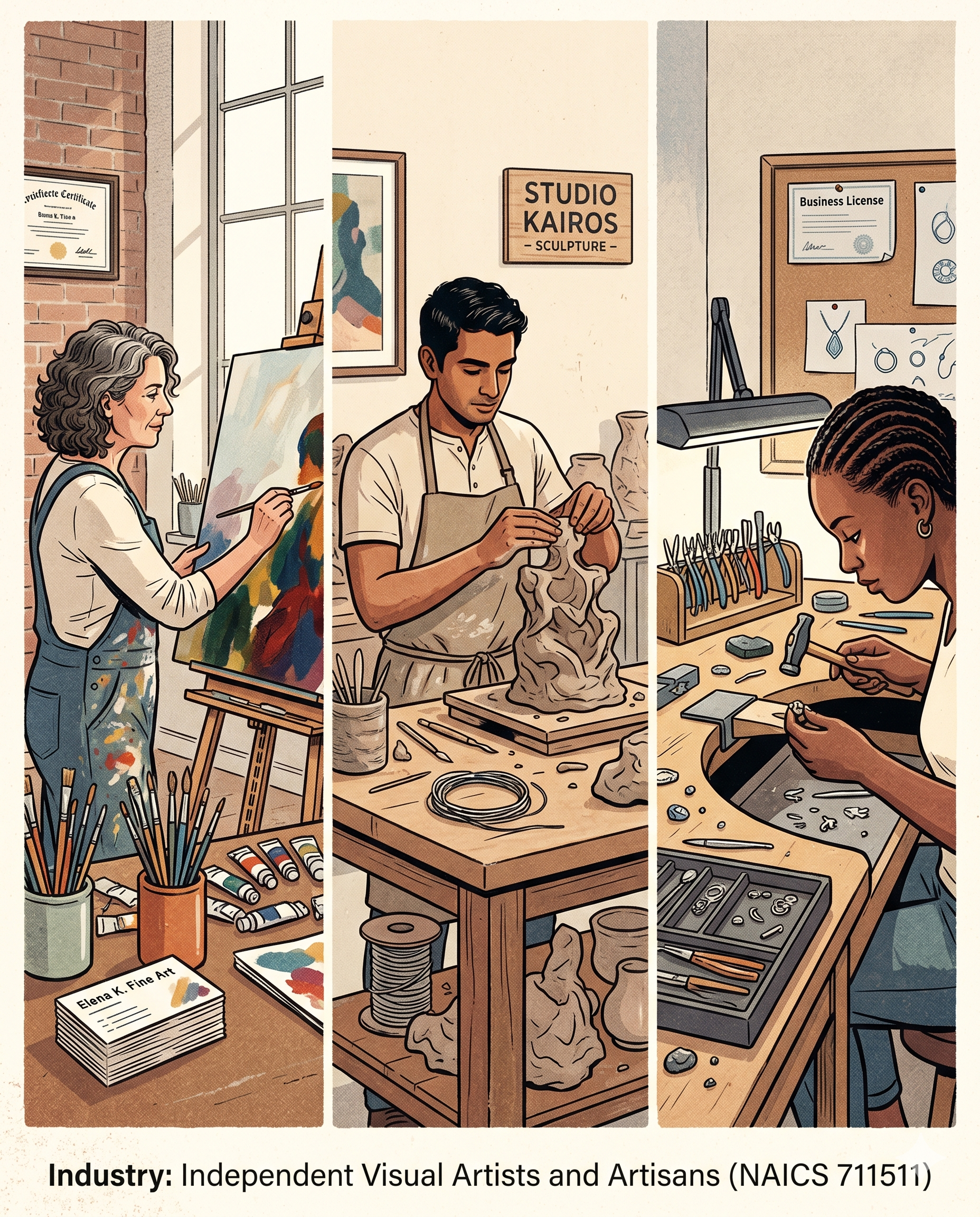
Industry: Independent Visual Artists and Artisans (NAICS 711511)
Business Structure: Registered Sole Proprietorship
Location: Central Alberta, Canada
You’re reading my reflection because you are trying to figure this out and find some answers. Really, when was the last time you actually felt good about doing your taxes?
Doing my taxes for my art business would freak me out. But this year was different—because I had been taking annual notes (I’m a teacher).
Why Alberta Artists Face Unique Tax Challenges
Maybe you took Strong’s Inventory when you were in high school or University. In the end, the inventory results will provide you with some code options like the Holland Codes (RIASEC). With more research, you may have come across the North American Industry Classification System. In University, that’s when I first heard about these NAICS numbers. So, if you're classified under NAICS code 711511 (Independent visual artists and artisans) like I am, you know the struggle: we're creating studio-based work in small quantities, often working alone, and our income can be 'variable.'
According to Statistics Canada, NAICS 711511 covers artists creating 'artistic and cultural objects, designed by the producing establishment, made in small quantities, of any material.'1 That's us—painters, sculptors, artisans, independent photographers—all navigating the same complex tax landscape.
And here's the kicker: as self-employed artists in Alberta, we face both federal tax rates (14.5% to 33%) and Alberta provincial rates (8% to 15%).2
But unlike salaried employees, we can deduct our business expenses. The question is: are you tracking them properly?
My art expense percentages from 2025.
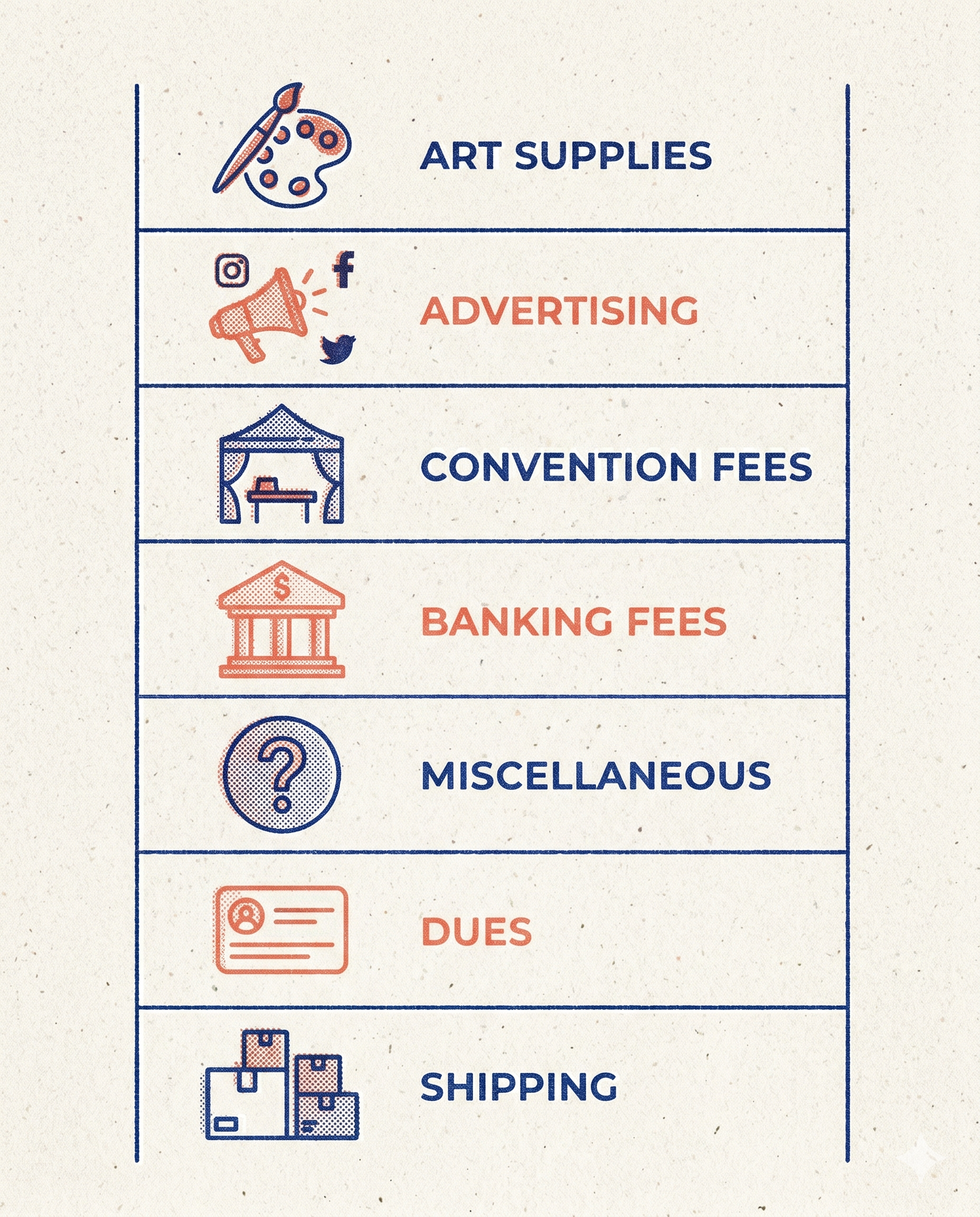
Expense Breakdown by Category
| Category | Vendors / Description |
|---|---|
| Supplies |
|
| Advertising |
|
| Convention Fees |
|
| Banking Fees | Bank Service Charge |
| Miscellaneous | Other Artwalks (after two claimed) |
| Dues |
|
| Shipping | Canada Post |
Notes:
After reflection, I will not be using some Vendors for 2026.
5% of the sales of my artwork goes to Mental Health in Canada l CMHA National. When I file, this is claimed under my donation section.
Step One: Making It Official (It's Easier Than You Think)
Before we get into the tax details, let's talk about something I wish I'd done earlier: getting a registered business number and setting up as a sole proprietorship.
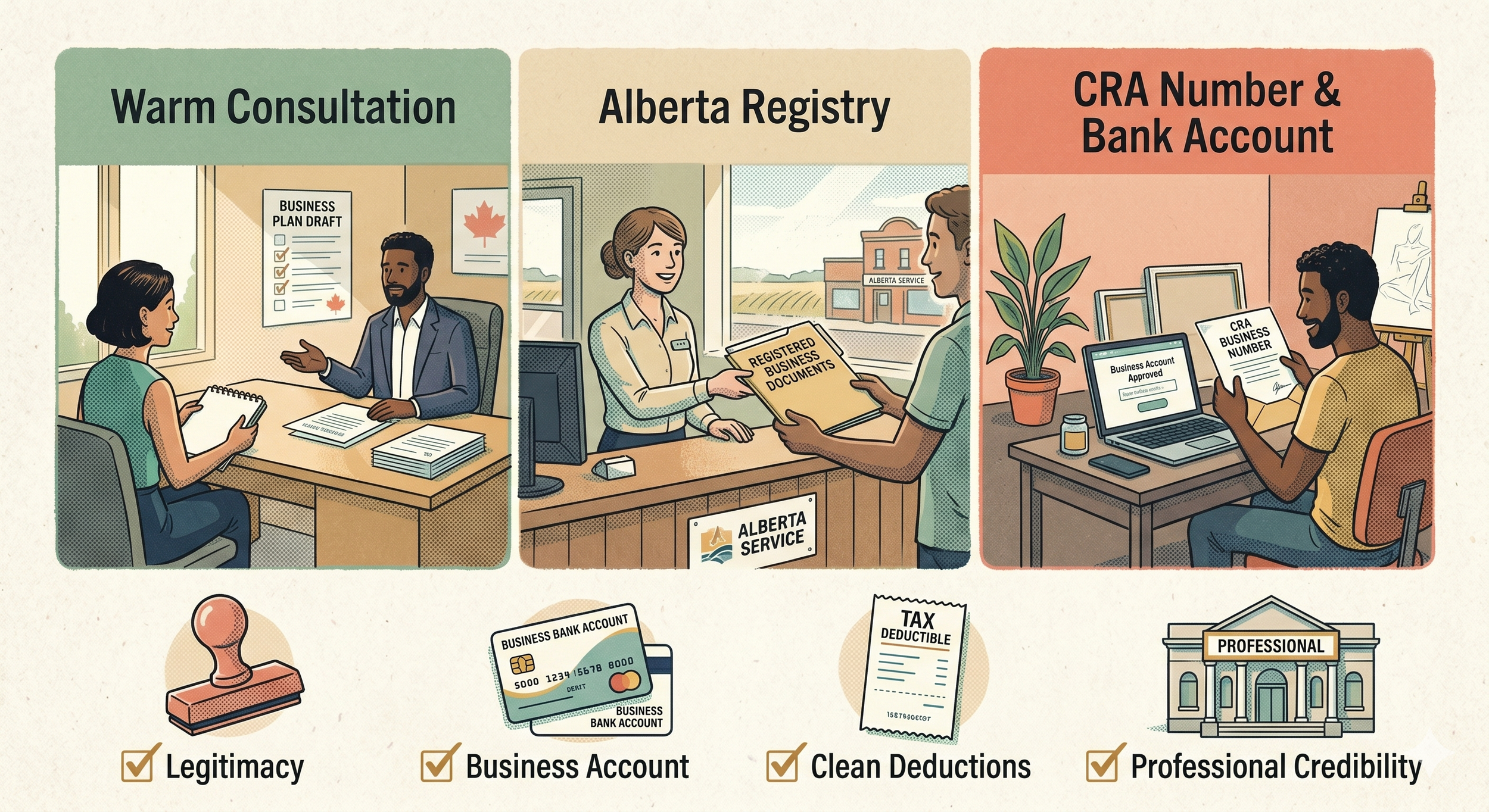
Here's the truth: it didn't cost much, and it wasn't complicated.
My process was simple:
1. I talked with a lawyer to understand my options and make sure I was doing this right.
2. I went to a local registry to register my business name.
3. I got my business number from the registry office (I think this is where I got it? It’s been a few years), so I could operate as a registered sole proprietorship.
Why does this matter for taxes? A few reasons:
✅ It legitimizes your art practice as a business (which CRA cares about)
✅ You can open a business bank account (absolute game-changer for tracking)
✅ It makes deducting expenses cleaner and more defensible
✅ You look professional to galleries, clients, and granting agencies
Don't overthink this step. If you're earning income from your art and want to claim expenses, being a registered sole proprietorship just makes everything easier. (Although what you register your business as, looks different for everyone)
Using TurboTax for My 2025 Return
I used TurboTax to file my 2025 taxes. Here's what the process looked like and how I answered the key questions:
1. What category best describes your self-employment work?
I selected Business.
2. What type of self-employment work do you do?
I entered Independent visual artists and artisans.
This is the classification that generally applies to independent visual artists and artisans under NAICS 711511.
3. Does your self-employment work have an official name?
Whatever your registered business name is.
4. Do you use your home address for this business?
If you have a home studio or use your home as your business address, select yes here.
5. What is your fiscal period?
I used the standard calendar year (January 1 to December 31).
6. What is your GST/HST number?
This is the 9-digit number CRA assigns to your business if you're registered for GST/HST. You need to register once your annual sales exceed $30,000.
7. Do any of these situations apply to your business?
I selected the options that applied to my work, including online sales where relevant.
If you sell through your website, Etsy, Instagram, or any online platform, check the box for online/website income.
8. How much of your income came from websites or web pages?
I entered the amount connected to online sales—either a dollar amount or a percentage of total sales.
9. What was your self-employment income?
I entered my total business income for the year. This includes all art sales, commissions, grants (if business income), and any other revenue from your art practice.
10. Did you sell products that you bought or manufactured?
This is the inventory question—and it's the most important one for artists.
CRA allows some self-employed visual artists to elect nil inventory treatment for original works they created, which may simplify reporting.7 That means unsold original work may be valued at zero for tax purposes.
Why this matters:
✅ You don't pay tax on unsold work sitting in your studio
✅ You only pay tax when you actually sell a piece
✅ It simplifies your accounting dramatically
✅ You don't have to calculate the 'cost' of each individual painting
Important: This election applies to original work you created yourself. It does NOT apply to reproductions (like prints you had made) or art supplies you bought to resell.8
I selected the nil inventory valuation option for my original paintings.
11. Do any of these situations apply?
I selected the GST/HST options that applied to my filing.
12. What GST/HST info do you need to enter?
I entered the total GST/HST collected or collectible from my return. If you collected GST/HST during the year, enter that total here. I charge taxes on all of my works. Prints and originals.
Helpful Resource:
TurboTax provides a self-employed expense checklist that can help you identify deductions:
Tracking Everything
Advertising platforms alone take significant time. I have to keep track of Google Ads, Meta (Instagram), Squarespace, Canva, Fine Art America, and ArtPlacer—each one has its own dashboard and billing structure. At year-end, I download PDFs from each platform and save them in different folders for my records. It's tedious, but necessary.
Amazon purchases are another beast. I use our family Amazon account, not a separate business account. But here's the trick: when I make art-related purchases, I select my business card at checkout. That way, those expenses show up on my business card statement automatically.
At tax time, Amazon lets you filter purchases by year, which helps. But you still have to go through each transaction and identify which ones were business-related. It can be annoying, but it's doable.
Pro tip: If you're buying art supplies on Amazon, always use your business payment method. It makes reconciliation so much easier when everything business-related flows through one card.
How I Did My Taxes This Year
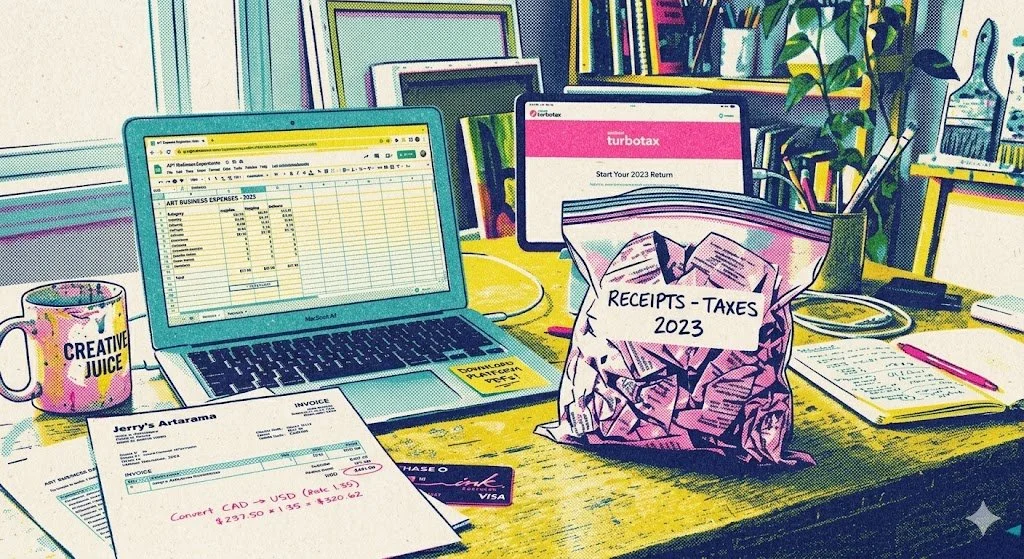
My system wasn't perfect. But it was better than previous years, and here's what worked:
1. I have a dedicated business bank account and business credit card. Every art-related transaction goes through one account or card, which makes tracking so much easier. Once I had my business number, opening these was straightforward.
2. I exported all my 2025 expenses and income. At year-end, I downloaded everything from my bank statements and all my advertising platforms. Then I categorized each transaction.
3. I re-categorized everything for TurboTax. This took time—more than I'd like to admit—but it gets easier every year as I learn CRA's categories.
4. I kept all physical receipts. I use a simple ziplock bag system. Not fancy, but it works. CRA requires you to keep records for at least 7 years?
5. I saved PDFs from all online platforms. One copy of everything, but in different platform folders. This includes advertising receipts, sales confirmations, letters—everything.
⚠️ Pro Tip for Artists Buying from the U.S.: Watch for currency exchange differences! The amount on your receipt won't always match your bank statement because of USD/CAD conversion.
What CRA Actually Says Self-Employed Artists Can Deduct
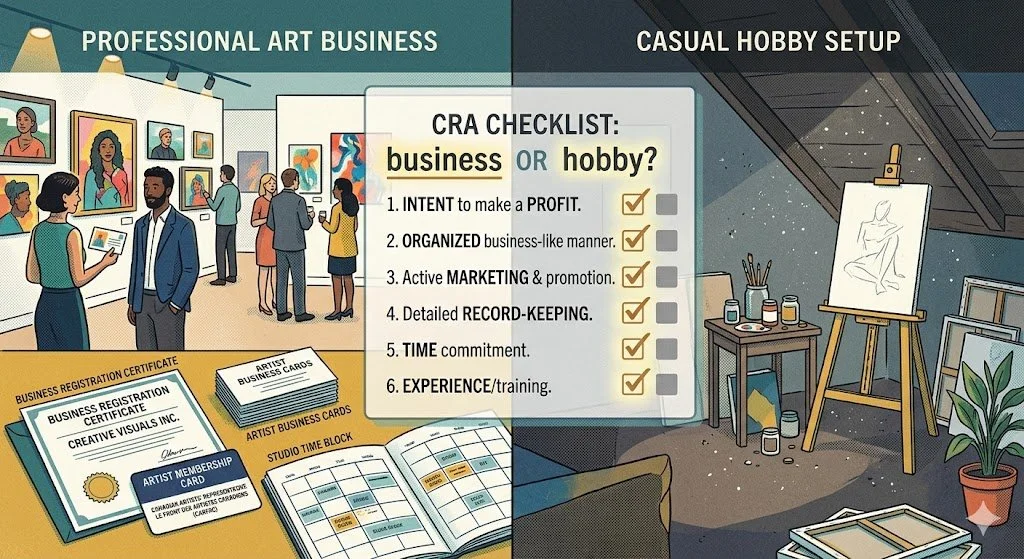
According to CRA's Income Tax Folio S4-F14-C1 (the official guidance for artists and writers), if you're self-employed and your artistic activity is 'undertaken in pursuit of profit' with 'objective evidence of business-like behaviour,' you can deduct reasonable expenses.
What does that mean? CRA looks at things like:4
• Time devoted to your art practice
• Public exhibitions and presentations of your work
• Representation by dealers or agents (I am represented by Artmatch)
• Marketing and promotion efforts
• Professional training and qualifications (I have a BFA)
• Membership in professional artist associations
• Being a registered business (this helps!)
You don't have to be profitable every year, but you need to show you're running it like a business, not a hobby.
Deductible Expenses that can be claimed
According to CRA, self-employed artists can deduct:5
✅ Art supplies and materials
✅ Studio rent or workspace-in-home expenses (if it's your principal place of business)
✅ Professional fees (accountant, lawyer, grant consultants)
✅ Business registration costs
✅ Advertising and promotion (Google Ads, Meta, Squarespace, Canva, etc.)
✅ Exhibition costs (framing, shipping, booth fees)
✅ Professional development (workshops, courses, artist talks)
✅ Vehicle expenses for business travel (mileage or actual expenses)
✅ Professional memberships and dues
✅ Bank fees and credit card fees from your business accounts
Track Everything, But Do It Your Way
There's no 'perfect' tracking system.
But for me, that's:
• A registered sole proprietorship (makes everything official)
• A business bank account and business card (non-negotiable)
• Using my business card for ALL art purchases, even on family accounts like Amazon
• A ziplock bag for paper receipts
• Downloading PDFs from every advertising platform and saving them in duplicate folders
• Exports from my buniess bank account
• Year-end categorization for tax time
What I'm Changing for 2026
Will I be proactive for next year? Maybe!! Ha ha
1. Tracking expenses monthly (not yearly)
2. Using a proper spreadsheet with categories already set up
3. Logging mileage for every art-related trip
4. Calculating my workspace deduction properly
5. Saving receipts digitally as I go—no more year-end PDF scramble
6. Setting calendar reminders to download advertising platform reports quarterly
The goal? Make April 2027 stress-free.
Where are you coming from?:
• Are you operating as a registered sole proprietorship, or are you still informal?
• Did you know about the nil inventory valuation option? Are you using it?
• How do you handle Amazon purchases—business account or family account with business card?
• What's your biggest pain point with tracking advertising expenses across multiple platforms?
• Are you claiming your workspace-in-home deduction?
• Have you ever been confused by currency exchange on U.S. purchases?
Drop a comment below or reach out—I'd love to hear what's working (or not working) for you.
References
1. Statistics Canada. (2022). NAICS 2022 Version 1.0 - 711511 - Independent visual artists and artisans. Retrieved from https://www23.statcan.gc.ca/imdb/p3VD.pl?Function=getVD&TVD=1369825&CVD=1370970&CPV=711511&CST=27012022&MLV=5&CLV=5
2. TurboTax Canada. (2025). 2025-26 Alberta Tax Calculator. Retrieved from https://turbotax.intuit.ca/tax-resources/alberta-income-tax-calculator
3. Canada Revenue Agency. (2025). 2025 income tax package for Alberta. Retrieved from https://www.canada.ca/en/revenue-agency/services/forms-publications/tax-packages-years/general-income-tax-benefit-package/alberta.html
4. Canada Revenue Agency. (2020). Income Tax Folio S4-F14-C1, Artists and Writers. Retrieved from https://www.canada.ca/en/revenue-agency/services/tax/technical-information/income-tax/income-tax-folios-index/series-4-businesses/folio-14-income-artistic-endeavours/income-tax-folio-s4-f14-c1-artists-writers.html
5. Canada Revenue Agency. (2020). Income Tax Folio S4-F14-C1, Artists and Writers - Expenses of self-employed artists and writers. Retrieved from https://www.canada.ca/en/revenue-agency/services/tax/technical-information/income-tax/income-tax-folios-index/series-4-businesses/folio-14-income-artistic-endeavours/income-tax-folio-s4-f14-c1-artists-writers.html
6. TurboTax Canada. (2025). 2025-26 Alberta Tax Calculator - Filing deadlines. Retrieved from https://turbotax.intuit.ca/tax-resources/alberta-income-tax-calculator
7. Canada Revenue Agency. (2020). Income Tax Folio S4-F14-C1, Artists and Writers - Visual artists' inventories (subsection 10(6)). Retrieved from https://www.canada.ca/en/revenue-agency/services/tax/technical-information/income-tax/income-tax-folios-index/series-4-businesses/folio-14-income-artistic-endeavours/income-tax-folio-s4-f14-c1-artists-writers.html
8. Income Tax Act, RSC 1985, c. 1 (5th Supp.), subsection 10(8). Retrieved from https://laws-lois.justice.gc.ca/eng/acts/i-3.3/page-4.html
About This Article
Keywords: Alberta artist taxes, self-employed artist Canada, NAICS 711511, visual artist tax deductions, Alberta tax rates 2025, artist business expenses, CRA artist guidelines, independent artist taxes Alberta, sole proprietorship artist, registered business artist Canada, artist tax filing, artist inventory valuation, tracking art expenses, Amazon business purchases
Location: Central Alberta, Canada
Industry Classification: NAICS 711511 - Independent Visual Artists and Artisans
Business Structure: Registered Sole Proprietorship
Note: TurboTax is a trademark of Intuit Inc. This article references the software as an educational resource for filing taxes and does not imply endorsement.