Does AI Make Art Look Like Other People’s Work?
A Transparent Look at Neotech Realism, Originality, and My Painting Process**
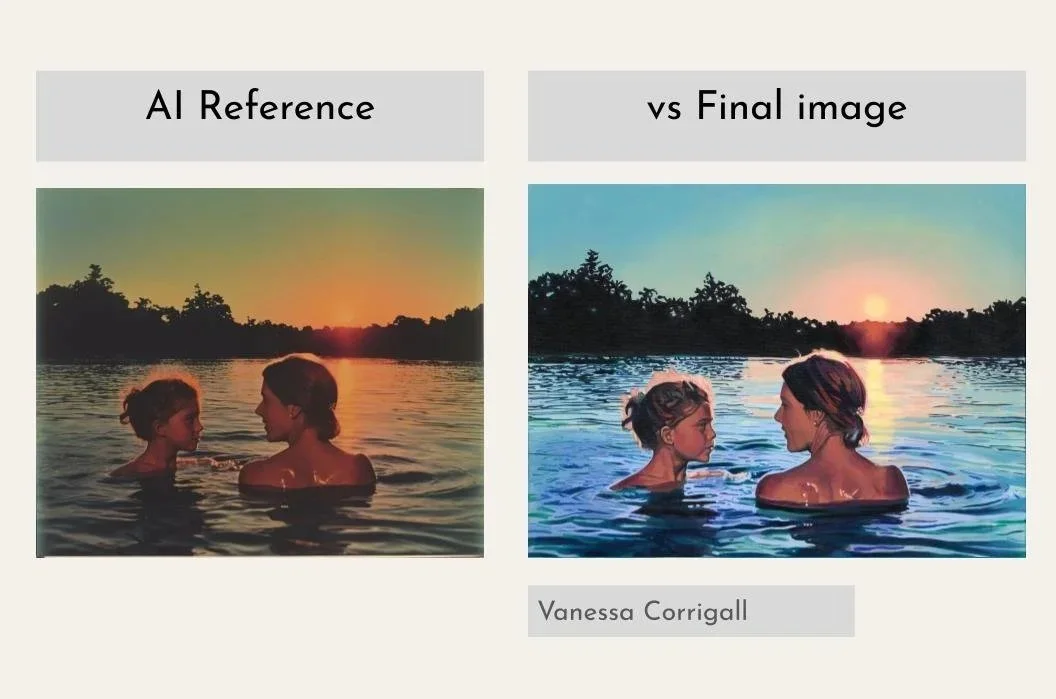
The conversations around AI art, originality, and ethics have become louder and more layered over the past few years. Collectors ask thoughtful questions. Art historians have entered the discussion. And many people simply want to understand how contemporary artists are navigating this technological shift.
One question I’m asked often is:
“If you use AI during your process, doesn’t that mean your art might look like someone else’s?”
It’s a genuine and understandable concern — especially when much of what the public sees online are AI images designed to imitate famous painters or popular styles. But what I’ve learned, both through practice and through testing my own work, is that this assumption doesn’t reflect how many artists actually use these tools today.
My studio practice falls within an emerging direction I call Neotech Realism:
a contemporary form of realism where digital tools assist the artist’s perceptual research, while the final artwork remains entirely hand-painted, intentional, and physically crafted.
This post is meant to give collectors, critics, and the simply curious a transparent, grounded view of what that actually looks like.
Why People Assume AI Art Looks the Same
There’s a reason this concern exists. The internet is full of examples where users intentionally prompt a program with phrases like:
“In the style of Monet”
“Make this look like a comic book”
“Paint this like Artist X”
These outputs circulate widely, creating a cultural myth that AI automatically clones artistic styles. In reality, AI reflects how it’s used. And in serious contemporary practice — especially within Neotech Realism — the intention is not imitation. It’s exploration.
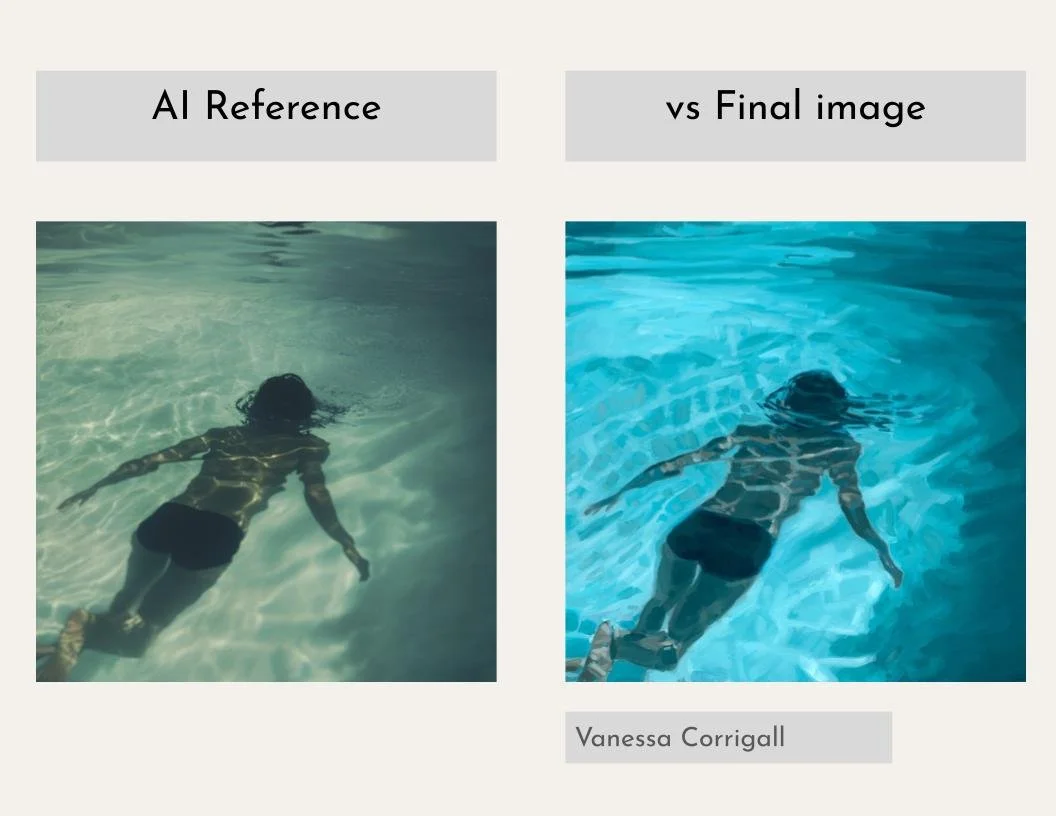
How Vanessa Corrigall reinterprets AI reference studies into original underwater paintings using Neotech Realism.
How I Actually Use AI (and Why It Doesn't Create the Art)
Let me be completely clear:
AI does not generate my paintings.
AI does not produce my compositions.
Nothing in the finished artwork is printed or generated.
AI appears only during my research stage — the same way a camera, projector, sketching app, or funhouse mirror has appeared in the workflows of countless artists before me.
Underwater environments are complex. Water refracts, stretches, compresses, and blurs forms in ways that cameras struggle to capture. Light scatters. Skin tones shift. Limbs distort.
AI allows me to study these physical behaviors in ways that are impossible to achieve with traditional reference tools. It’s not giving me an artwork — it’s giving me information.
Once that exploration is complete, the rest is traditional:
drawing by hand
refining the composition
building layers of acrylic
glazing, editing, adjusting
shaping colour relationships
physically painting every inch
This is the heart of Neotech Realism:
technology expands perception, but the hand defines the artwork.
What the Reverse Image Search Really Revealed
To satisfy my own curiosity — and to answer questions I knew collectors might ask — I ran reverse image searches on several of my finished paintings.
What appeared was not a list of duplicates by other artists.
Instead, the search results matched…
my paintings with my other paintings.
At first, this made me laugh. Then I realized just how meaningful this was.
1. My paintings resemble one another because I have a coherent visual language.
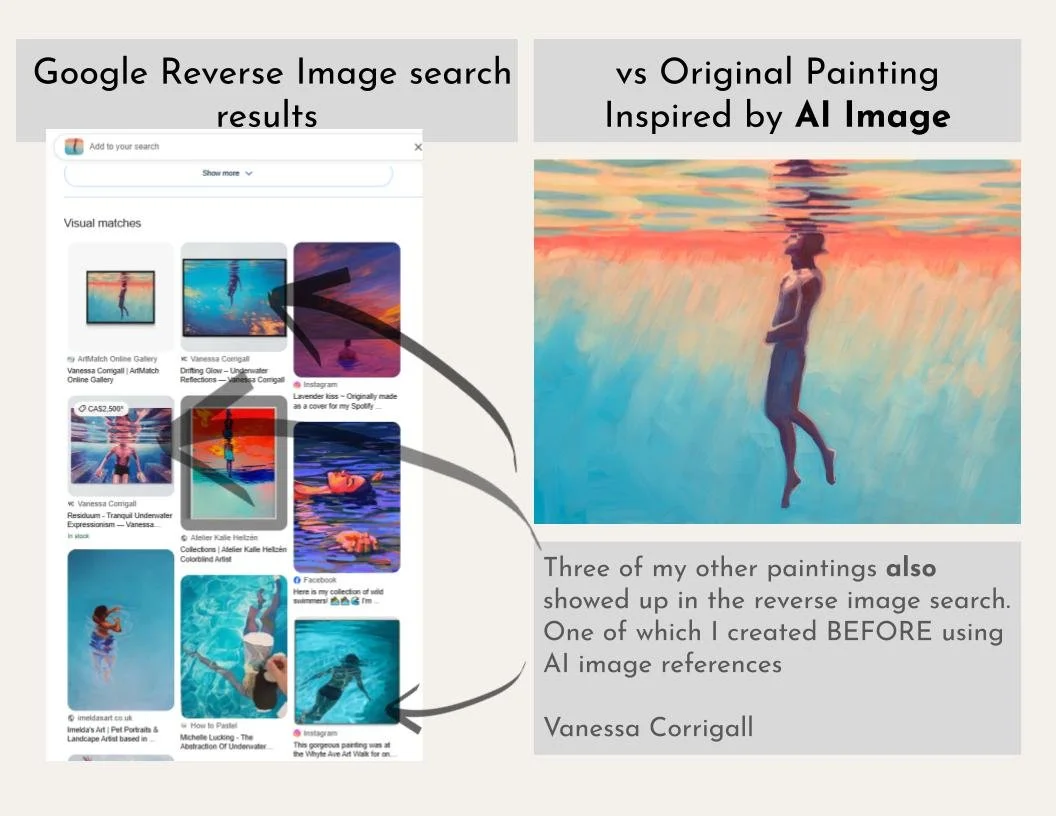
Google reverse image search shows Vanessa Corrigall’s own paintings as matches, highlighting her consistent Neotech Realism style.
Reverse image algorithms look for patterns — colour, motion, texture, subject matter. Because my underwater work explores refraction, distortion, surface shimmer, and immersion, these elements naturally appear across multiple pieces.
This isn’t duplication.
It’s signature — the foundation of collectability.
Critics, curators, and art historians recognize this as the point where an artist's voice becomes unmistakable.
2. The algorithm was clustering by genre, not declaring sameness.
Google Lens doesn’t understand originality. It cannot interpret creative intention. It simply groups images with shared features:
figures underwater
turquoise & coral light
swimmers
rippling distortions
Genre similarity is not artistic replication.
If it were, every impressionist landscape would collapse into a single painting.
3. None of the “similar images” reproduced my compositions.
Not one result repeated:
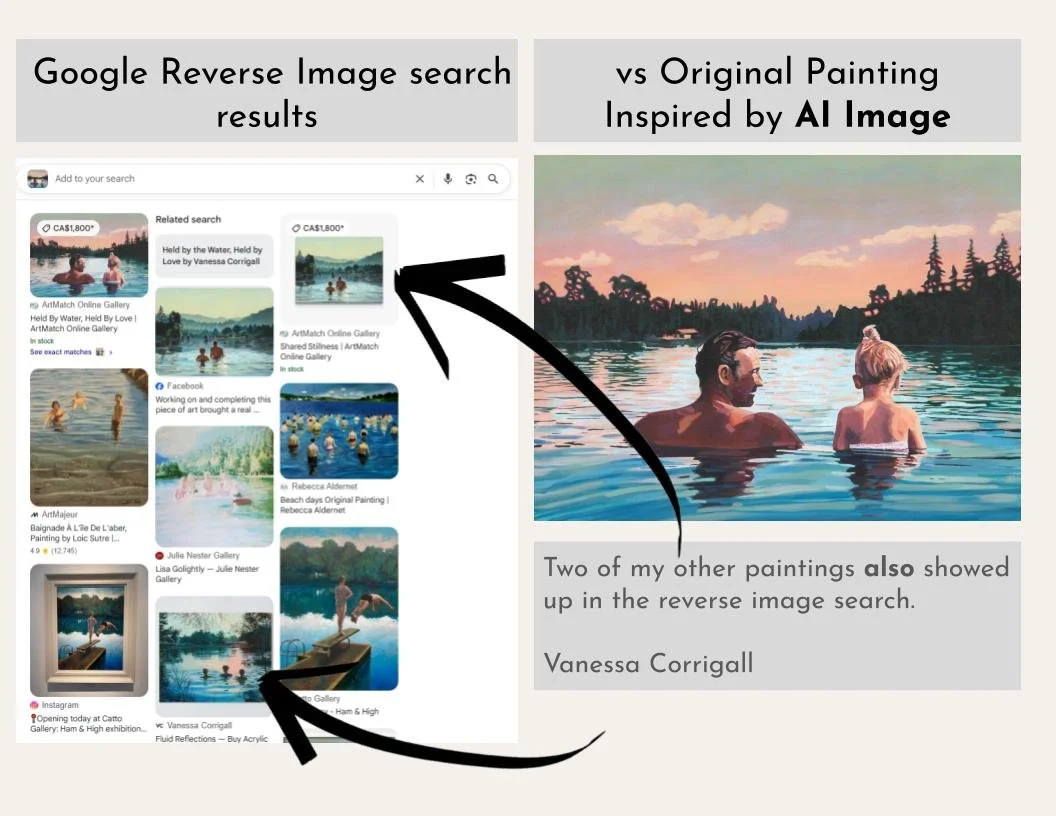
Google reverse image search shows Vanessa Corrigall’s own artworks as visual matches, demonstrating her consistent Neotech Realism style.
my angles
my colour structures
my distortions
my cropping
my refraction patterns
my emotional tone
Even when the algorithm showed works by other underwater painters, none were true matches — only thematic cousins.
4. The results confirmed something important: my work is distinct within its genre.
The algorithm recognized that my pieces form a cohesive set — yet did not confuse them with anyone else’s.
For an artist working in Neotech Realism, this is exactly the point:
AI helps me explore light and physics, but my hand, decisions, and intuition create the painting.
The result is recognizably mine — and only mine.
Why Some AI Art Looks Similar (and Why Mine Doesn’t)
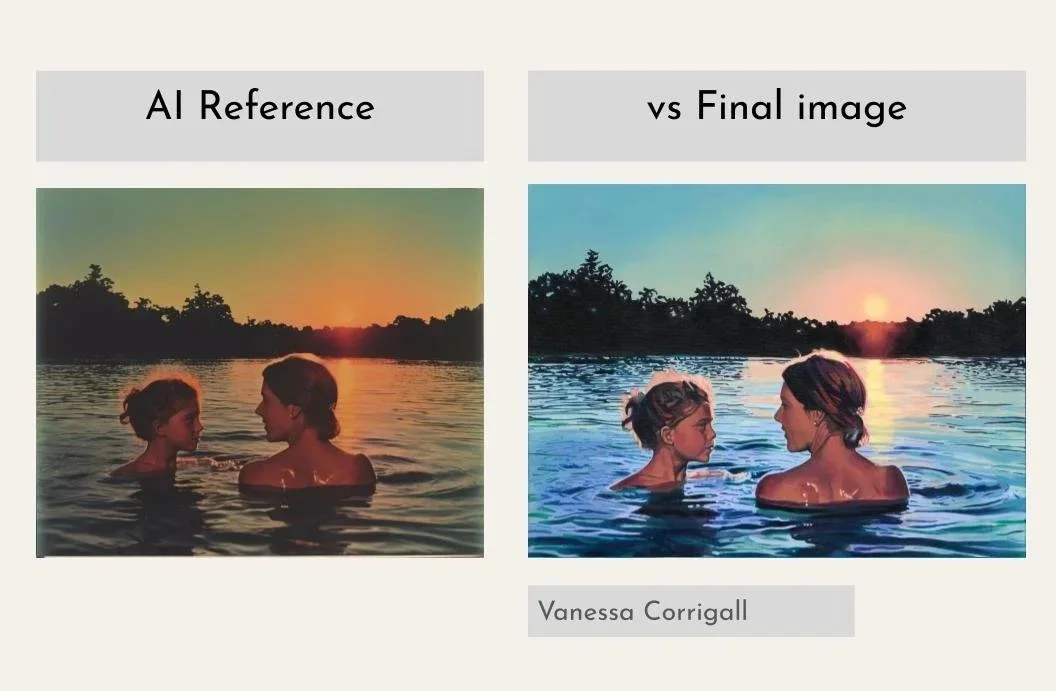
Vanessa Corrigall transforms AI reference studies into original hand-painted works in her Neotech Realism style.
AI can mimic style when someone asks it to. That’s how you get “Van Gogh-style sunsets” or “Renaissance portraits with robots.” But my process has absolutely nothing to do with stylistic imitation.
My prompts are about physics:
How does light break underwater?
How does motion bend a limb?
How do colours dissolve at depth?
How does immersion shift perception?
These are questions of reality, not aesthetics.
And reality has no single artistic owner.
The Heart of My Work: What Makes It Mine
Regardless of tools, style comes from experience, curiosity, and the hand.
My work is shaped by:
my underwater colour vocabulary
my interest in perception, memory, and dissociation
my long study of Alberta’s swimming culture
my brushwork and layering process
years of observing how bodies move through water
These elements cannot be automated.
They come from lived practice.
Neotech Realism doesn’t reduce individuality — it heightens it.

Projecting the image to speed up results
A Long Line of Artists Using New Tools
Throughout art history, new tools have always caused concern:
Oil paint in tubes shocked academic painters.
Cameras were accused of destroying realism.
Projectors were once taboo.
Photoshop rewired the entire illustration world.
Yet each tool eventually expanded what art could be.
AI is simply the newest chapter in that story.
And like every chapter before it, what matters most is how the artist uses the tool — not the tool itself.
Why Transparency Matters
I believe the relationship between artist and collector is built on trust.
Sharing my process openly isn’t about defending it — it’s about connecting.
Most people are relieved, even excited, when they hear the real story:
nothing is generated
everything is hand-painted
AI is only a research tool
the originality is verifiable
the style is consistent because the voice is consistent
Transparency isn’t a disclaimer.
It’s part of the work.
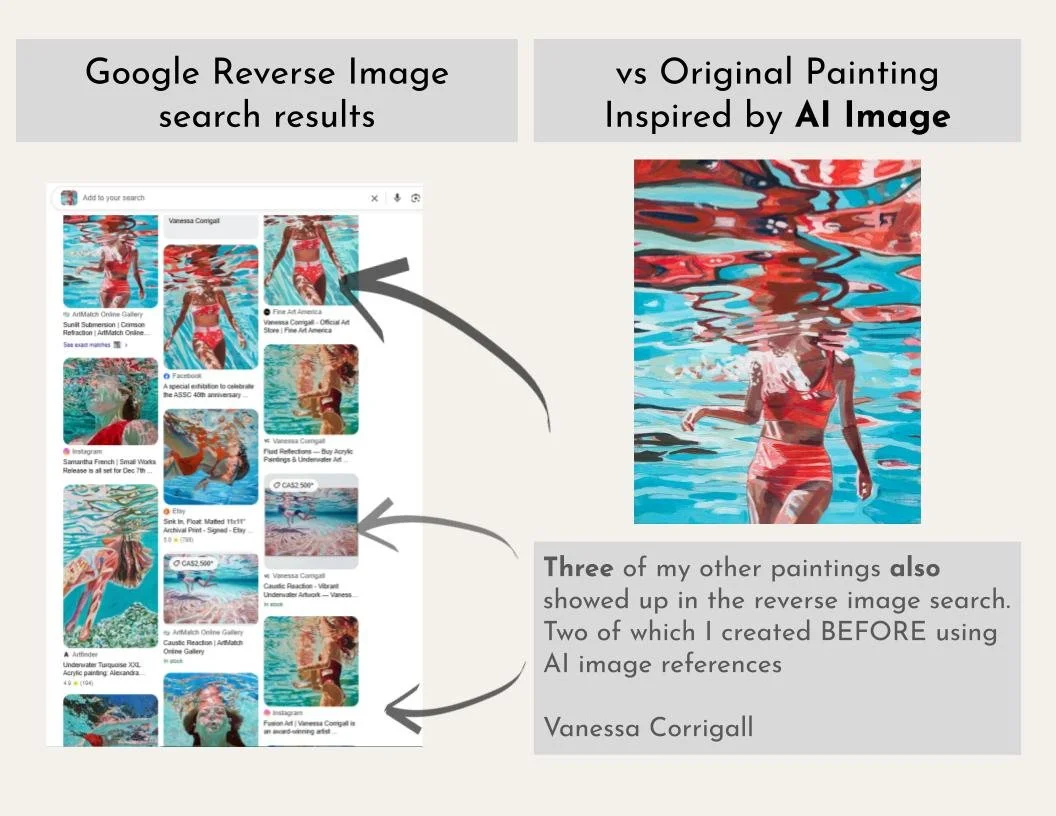
Reverse image search shows Vanessa Corrigall’s own paintings as visual matches, demonstrating her consistent Neotech Realism style.
What AI Actually Gives Me
AI expands my ability to explore:
impossible angles
surreal distortions
light scatter and absorption
the physics of water
emotional states connected to immersion
This is the essence of Neotech Realism —
technology extending perception, not replacing creation.
The tool broadens the questions I can ask.
The painting answers them.
Closing: Originality, Neotech Realism, and the Future of Painting
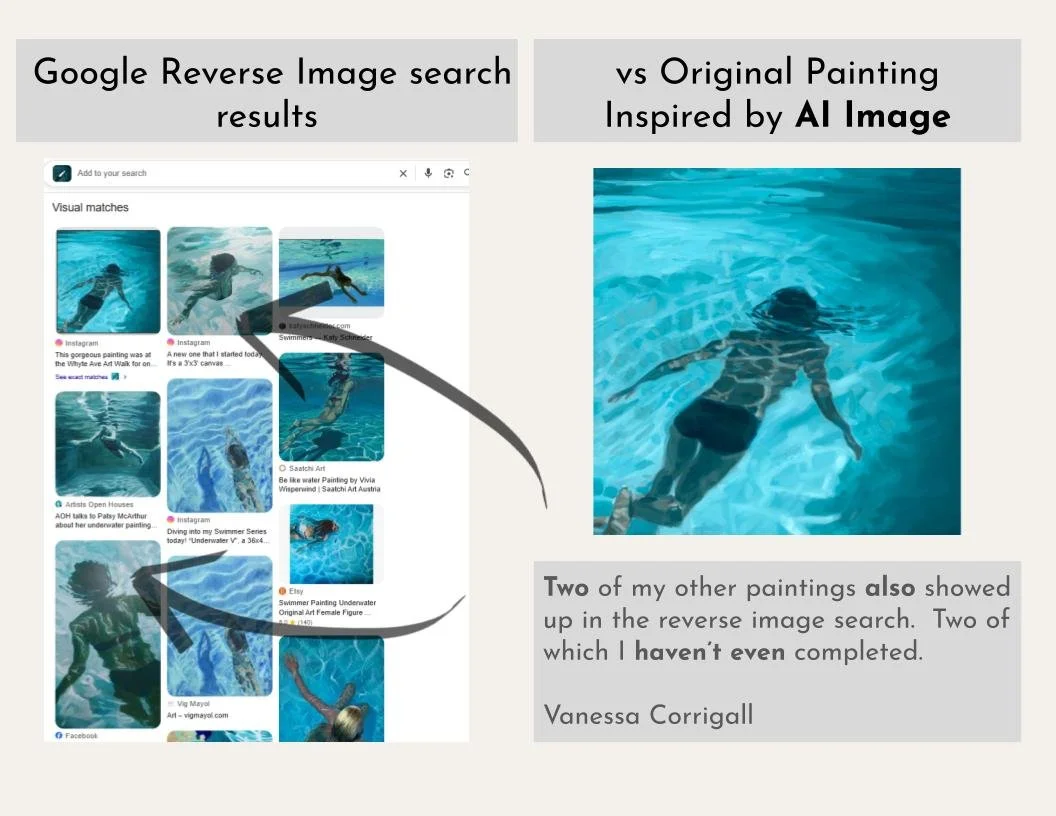
Reverse image search groups Vanessa Corrigall’s own artworks together, showing a consistent Neotech Realism style developed independently of AI references.
So, does using AI mean my artwork might resemble someone else’s?
No. It means my artwork resembles my own — as it should.
The reverse image searches confirmed what I feel every time I paint:
my body of work is cohesive
my visual language is distinct
my compositions are original
my style is recognizable
my technique is my own
This is the foundation of Neotech Realism:
a fusion of contemporary tools, traditional handcraft, and a deeply personal relationship with water, perception, and memory.
If you’d like to explore this work in person, see upcoming exhibitions, or learn more about the ideas behind the paintings, I’d love to connect.
You can join my mailing list, visit my exhibitions, or explore available works on my website — and be part of the evolving conversation around art, technology, and the future of realism.