Tolstoy, Beauty, Culture, and Why We’ve Never Agreed Anyway
Written by Vanessa Corrigall, Chat GPT 5.2, and Perplexity AI
In recent years, conversations about AI-generated art have become increasingly polarized. Scroll through social media or comment sections and you’ll see people arguing as if there is one correct way to define art — and one correct stance on whether AI belongs in it at all.
But this kind of disagreement isn’t new.
While listening to What Is Art? by Leo Tolstoy, I was struck by how familiar these arguments felt. Long before algorithms, neural networks, or image generators existed, thinkers were already deeply divided on what art is, what beauty means, and what role culture, morality, and emotion should play.
Tolstoy doesn’t rush to his conclusion. Instead, he spends pages wrestling with other philosophers, traditions, and cultural views on aesthetics — almost as if to prove a quiet point: we have never agreed on art, even among the greatest thinkers in history.
That realization reframes today’s AI debates in a surprising way.
Art as Beauty, Harmony, and Form
One of the first ideas Tolstoy critiques is the long-standing belief that art is the creation of beauty — something harmonious, unified, and pleasing to the senses. This definition feels familiar to anyone who has studied the elements of art and principles of design: balance, unity, rhythm, proportion.
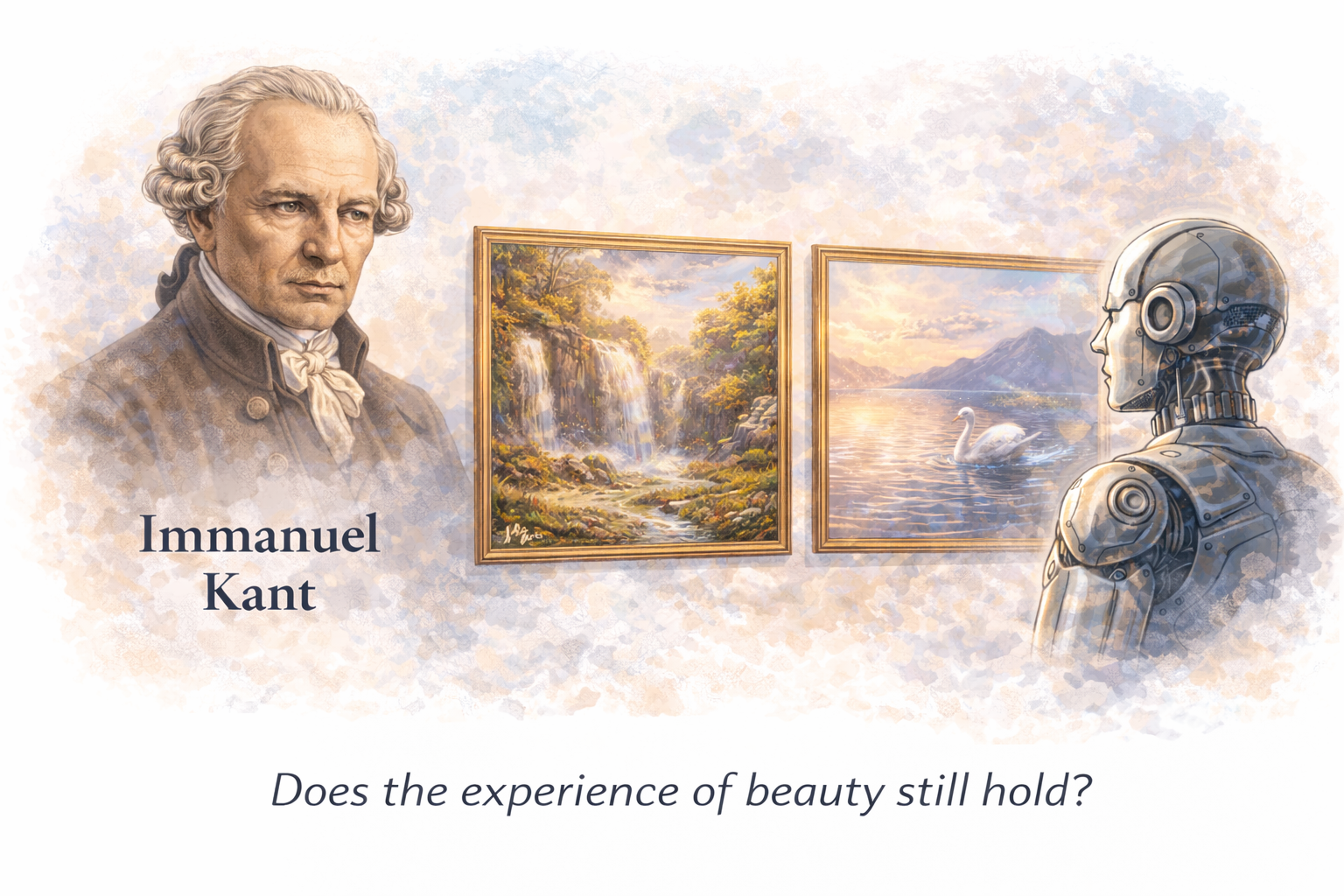
Philosophers like Immanuel Kant argued that beauty should be experienced with “disinterested” pleasure — meaning we judge art not by usefulness or morality, but through calm, detached contemplation. Beauty, in this view, is something we recognize almost instinctively, as if the artwork and our mind are in quiet agreement.
Applied to AI art, a Kantian question might sound like this:
If an image produces a genuine aesthetic experience, does it matter who — or what — made it?
Under this lens, authorship matters less than the felt quality of the experience. The key issue is whether the artwork can still evoke that disinterested, reflective sense of beauty, regardless of whether a brush, a camera, or a prompt produced it.
Art as Imitation and Skill
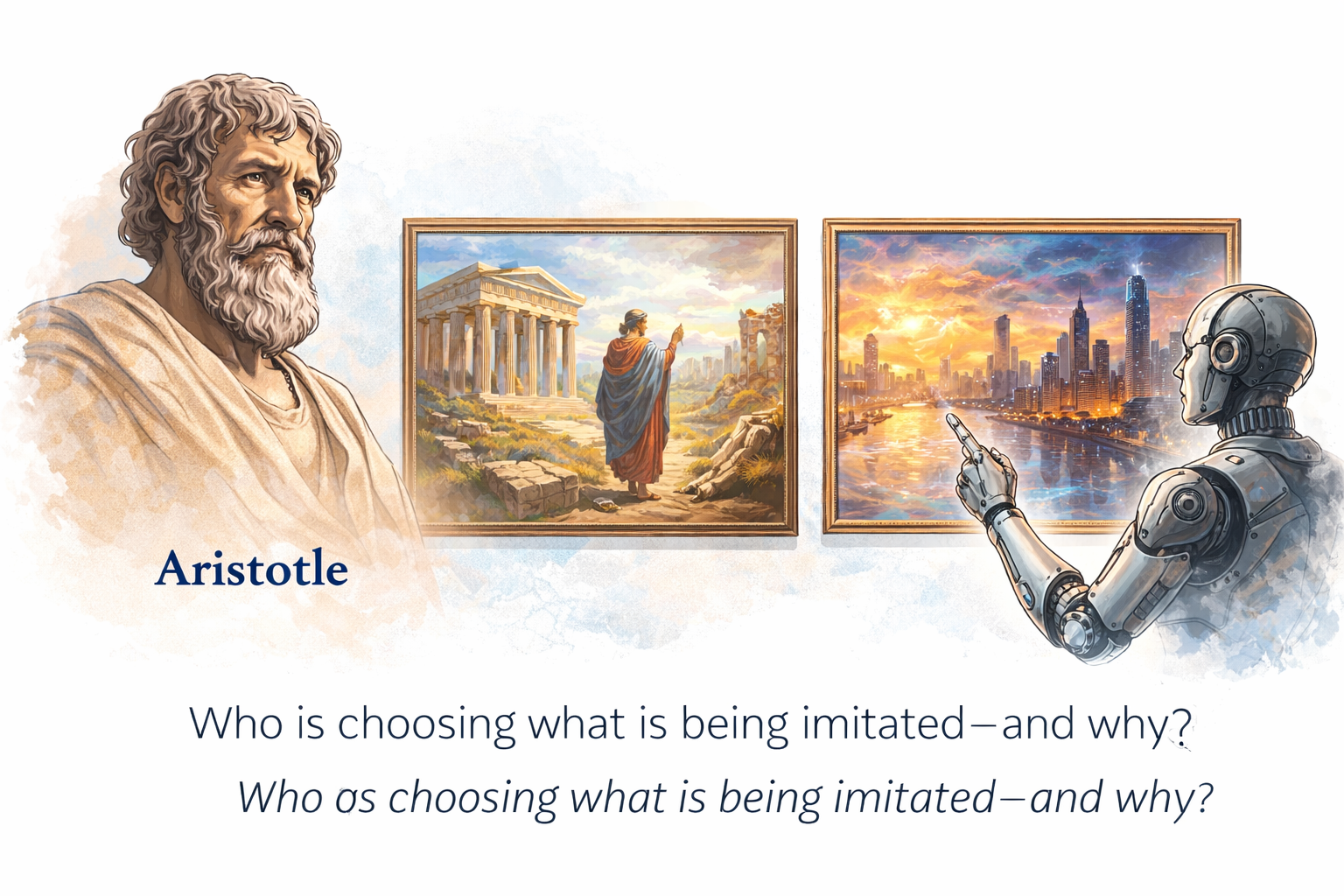
Much earlier, Aristotle described art as mimesis — imitation of life and nature. Art, for him, was not deception, but interpretation. The artist selected, emphasized, and reshaped reality to reveal something meaningful, often in a more concentrated or clarified form than everyday life.
From this perspective, AI’s ability to imitate styles, scenes, or visual patterns wouldn’t automatically disqualify it. The important questions shift away from “Is this copying?” toward something more pointed:
Who is choosing what is being imitated — and why?
Even here, intention matters. Tools assist, but meaning still requires human direction. If a person is deliberately using AI to highlight aspects of reality, experiment with form, or tell a story, then the “art” might lie in the choices made — which data, which style, which prompt, which edits — rather than in the tool itself.
Art as the Expression of Human Spirit
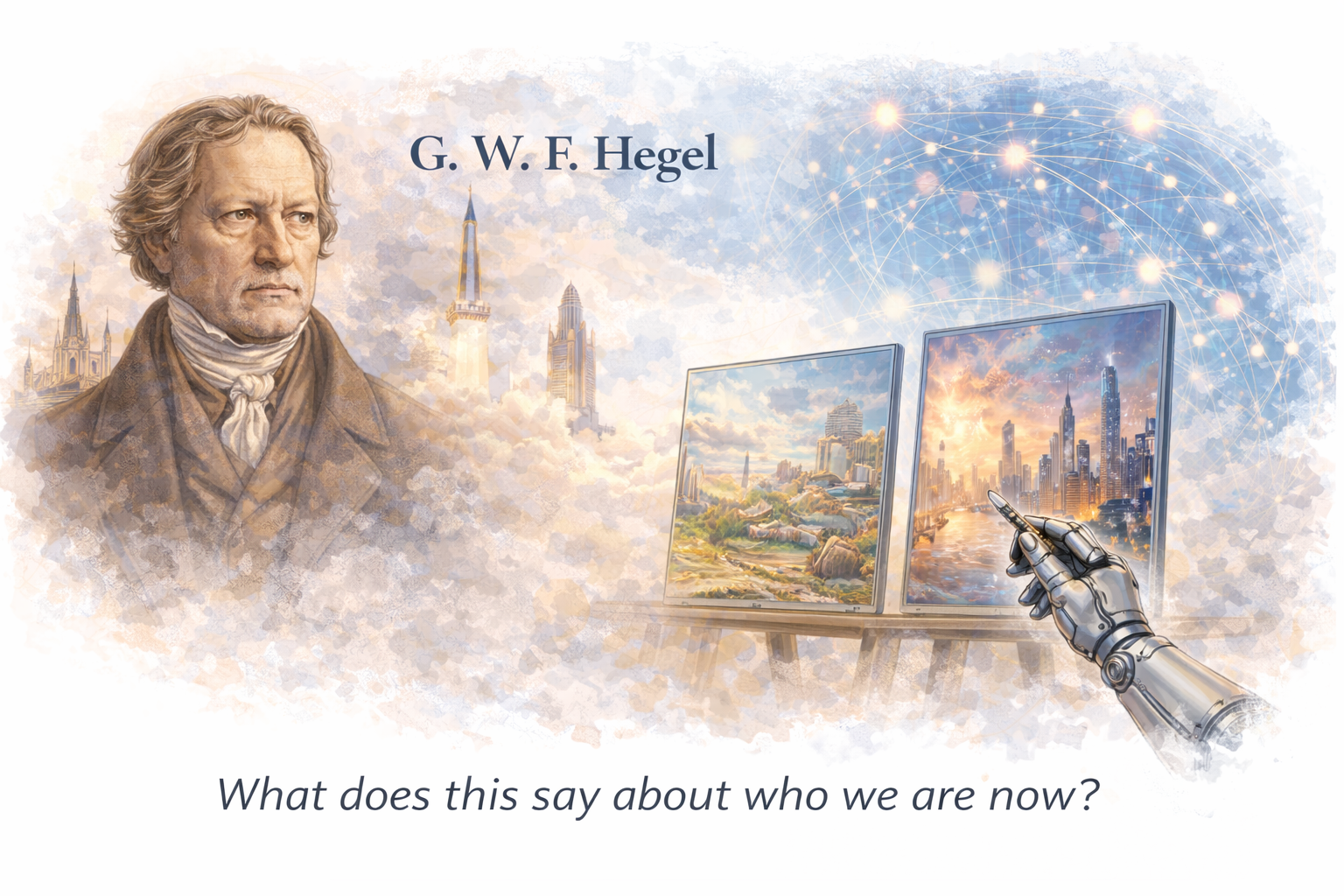
Later thinkers like G. W. F. Hegel believed art reflected the unfolding of human consciousness through history. Art was not static; it evolved alongside culture, technology, religion, and social life. In this view, artworks belong to their time as much as to their creators.
From a Hegelian lens, AI art might be interpreted not as a replacement for human creativity, but as evidence of a new historical moment — revealing how we think, work, and relate to tools in this era. The presence of AI in art becomes a symptom of broader shifts in our society: digitization, automation, globalization, and the blurring of boundaries between human and machine.
The question wouldn’t be “Is this real art?”
It would be “What does this say about who we are now?”
AI images, music, and texts then become artifacts of our present stage of consciousness — a way to read our anxieties, hopes, and experiments with what it means to be human.
Tolstoy’s Radical Turn: Art as Emotional Transmission
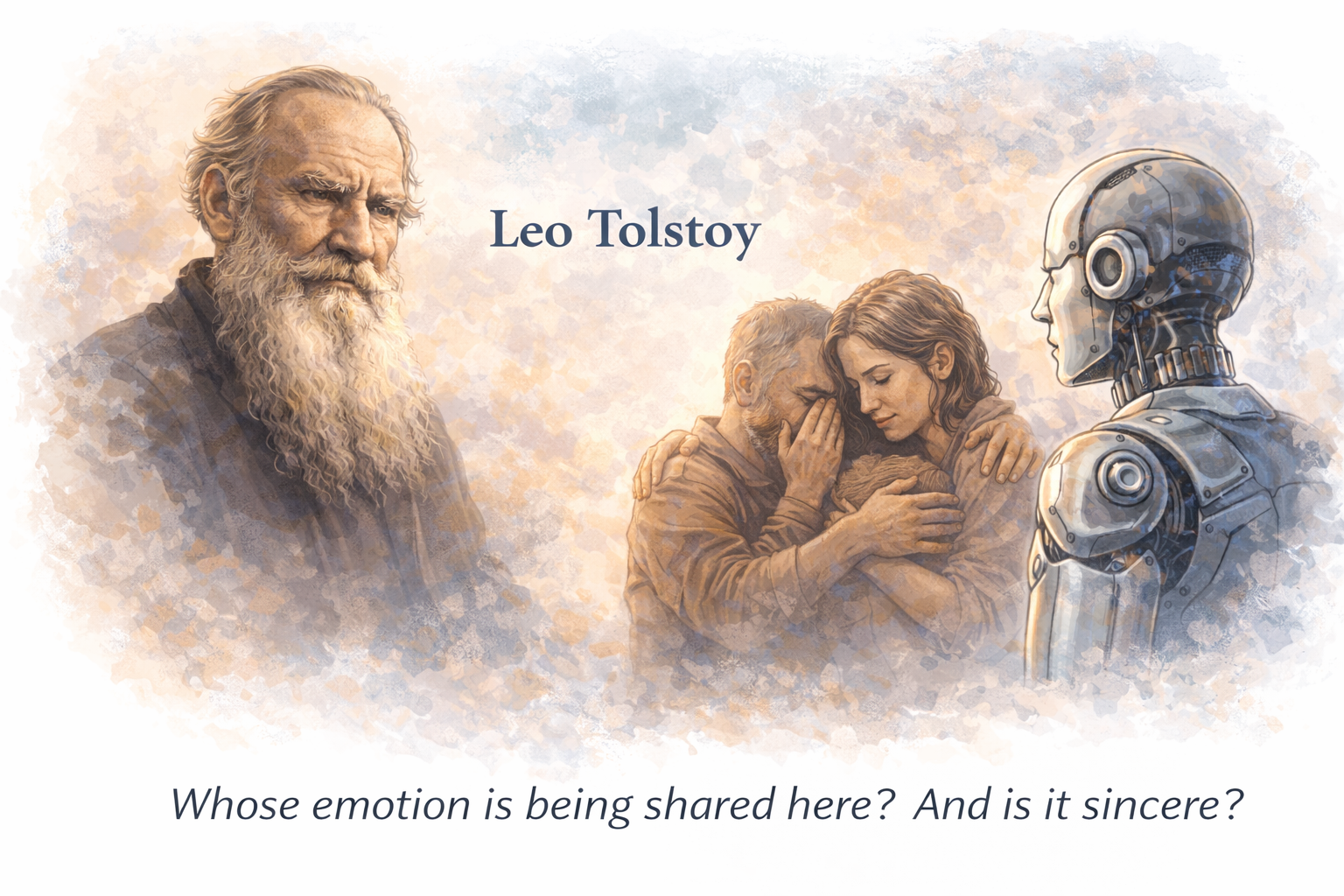
Tolstoy ultimately rejects beauty-based definitions altogether. For him, art is not about harmony or technical skill. It is about the sincere transmission of emotion from one human being to another.
An artwork, in this view, succeeds when it “infects” the audience with the feeling the artist experienced — when it creates a shared emotional space that unites people, even across time and culture. If a work does not carry genuine feeling, or if it fails to communicate that feeling to others, Tolstoy thinks it falls short of its purpose.
This is where Tolstoy’s deeply spiritual worldview enters. His vision of art is moral, connective, and human-centered. From this stance, AI art becomes problematic not simply because it uses technology, but because a machine cannot feel.
Tolstoy would likely ask:
Whose emotion is being shared here? And is it sincere?
Here, things get interesting. Even if a model itself has no feelings, a person may still use it to communicate their own. A Tolstoyan might therefore accept some AI-enabled works — where the human creator’s feeling is clear and genuinely communicated — and reject others that feel empty, derivative, or purely aimed at novelty or profit. The line is not “AI = bad,” but “insincere, unshared feeling = not art.”
The Philosopher Who Would Push Back: Nietzsche
Not everyone agreed with Tolstoy — strongly.
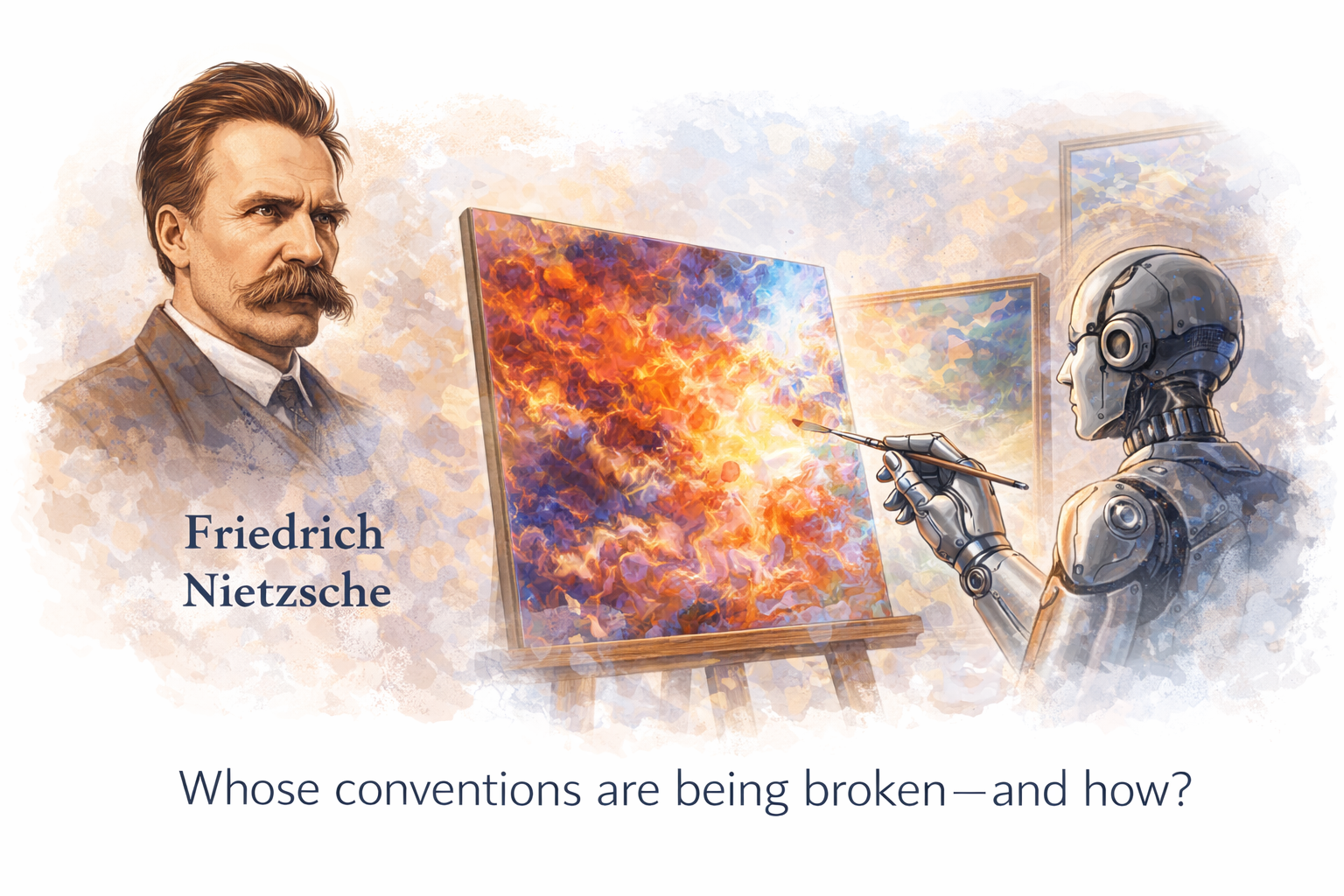
Friedrich Nietzsche saw art as life-affirming, disruptive, and often uncomfortable. He distrusted moral gatekeeping and any attempt to make art serve universal ethical rules. For him, art was tied to vitality, intensity, and the interplay between order and chaos — what he famously called the Apollonian and Dionysian.
From this angle, talk about “sincere emotion” and “moral uplift” as the main tests for art would sound restrictive. Nietzsche might be skeptical of AI art that simply reproduces sameness, reinforces clichés, or smooths over tension to please an algorithm. But it’s easy to imagine him being intrigued by AI used to break conventions, destabilize norms, or provoke new ways of seeing.
For him, the danger wouldn’t be AI itself — it would be complacency. If AI is used to mass-produce safe, forgettable images that dull our senses, then it undermines art. If it is pushed to generate strange, challenging, and genuinely unsettling work, it might actually support his ideal of art as a force that jars us awake.
Culture, Context, and Why Definitions Shift
One of the most overlooked parts of What Is Art? is Tolstoy’s attention to cultural difference. He acknowledges that what counts as meaningful art varies across nations, communities, and traditions. What deeply moves one group may leave another untouched.
Beauty is not universal. Meaning is not universal.
They are shaped by values, history, and lived experience.
This matters deeply in today’s conversations about AI, especially when global tools collide with local cultures, Indigenous knowledge systems, and community-rooted art practices. AI models are typically trained on vast, scraped datasets that reflect particular histories of power, visibility, and exclusion. A single definition of art has never fit everyone — and a single, global technical pipeline won’t either.
As AI tools spread, they may amplify certain aesthetics while flattening others, or they may be creatively appropriated and reshaped by communities in ways the original designers never imagined. Any serious conversation about AI and art has to ask not just “What is art?” but “Whose art, on whose terms, using whose data?”
| Thinker | Core View of Art | What Matters Most | View on Beauty | Likely View on AI Art | The Question They’d Ask |
|---|---|---|---|---|---|
| Aristotle | Art is mimesis (imitation of life and nature) | Interpretation, intention, selection | Secondary to meaning | Cautiously open — AI can imitate, but meaning depends on human choice | Who is choosing what is being imitated — and why? |
| Immanuel Kant | Art produces beauty through “disinterested pleasure” | Aesthetic experience itself | Central | Neutral to mildly open — authorship matters less than experience | Does the experience of beauty still hold? |
| G. W. F. Hegel | Art expresses the evolving human spirit | Historical and cultural meaning | Contextual | Curious — AI may reflect a new historical stage | What does this art reveal about our time? |
| Leo Tolstoy | Art transmits sincere human emotion | Emotional sincerity and moral connection | Rejected as primary definition | Largely opposed — machines cannot feel | Whose emotion is being shared, and is it sincere? |
| Friedrich Nietzsche | Art affirms life, disruption, and becoming | Vitality, transformation, challenge | Distrusted | Selectively open — supports AI that breaks norms | Does this create something new — or just repeat? |
Personality, Openness, and Why People Disagree So Strongly
Another useful lens comes from psychology rather than philosophy: the Big Five personality traits, often remembered as OCEAN. One of these traits, Openness to Experience, captures how someone responds to novelty, complexity, and ambiguity.
People high in Openness tend to be curious, imaginative, and eager to explore new tools and ideas. They are more likely to experiment with AI art, play with prompts, and treat the technology as a creative collaborator rather than a threat. People lower in openness often value tradition, continuity, and established methods, which can make rapid technological change feel destabilizing instead of exciting.
This doesn’t make one group right and the other wrong. It helps explain why AI art debates feel so emotional: they touch identity, values, and comfort with change, not just aesthetics. When someone says “AI art is killing creativity” and someone else responds “AI is just another tool,” they might not only be arguing about art theories — they might be expressing different temperaments and different ways of relating to change itself.
So… What Is Art Now?
If history teaches us anything, it’s this:
Great thinkers have always disagreed about art.
Definitions shift with culture and technology.
Tools do not erase discernment — they expose it.
AI doesn’t end the conversation about art. It continues it.
Just as photography, industrial tools, and digital media once did, AI forces us to clarify what we value: emotion, skill, meaning, authorship, connection, disruption, or transformation. It asks us to say, more honestly than before, what we are actually looking for when we call something “art.”
Tolstoy didn’t give us a final answer. Neither did Kant, Aristotle, Hegel, or Nietzsche.
What they gave us is a set of questions, tensions, and lenses — reminders that art has never been one thing, and that our arguments about it are part of what keep it alive. In the age of AI, that may be the most important tradition we’re still continuing.